
Pennsylvania Marijuana Law After the 2026 Election
Democrats won the state Senate on November 3, but recreational marijuana is still illegal in Pennsylvania. Here is what the law allows today and where people still get charged.
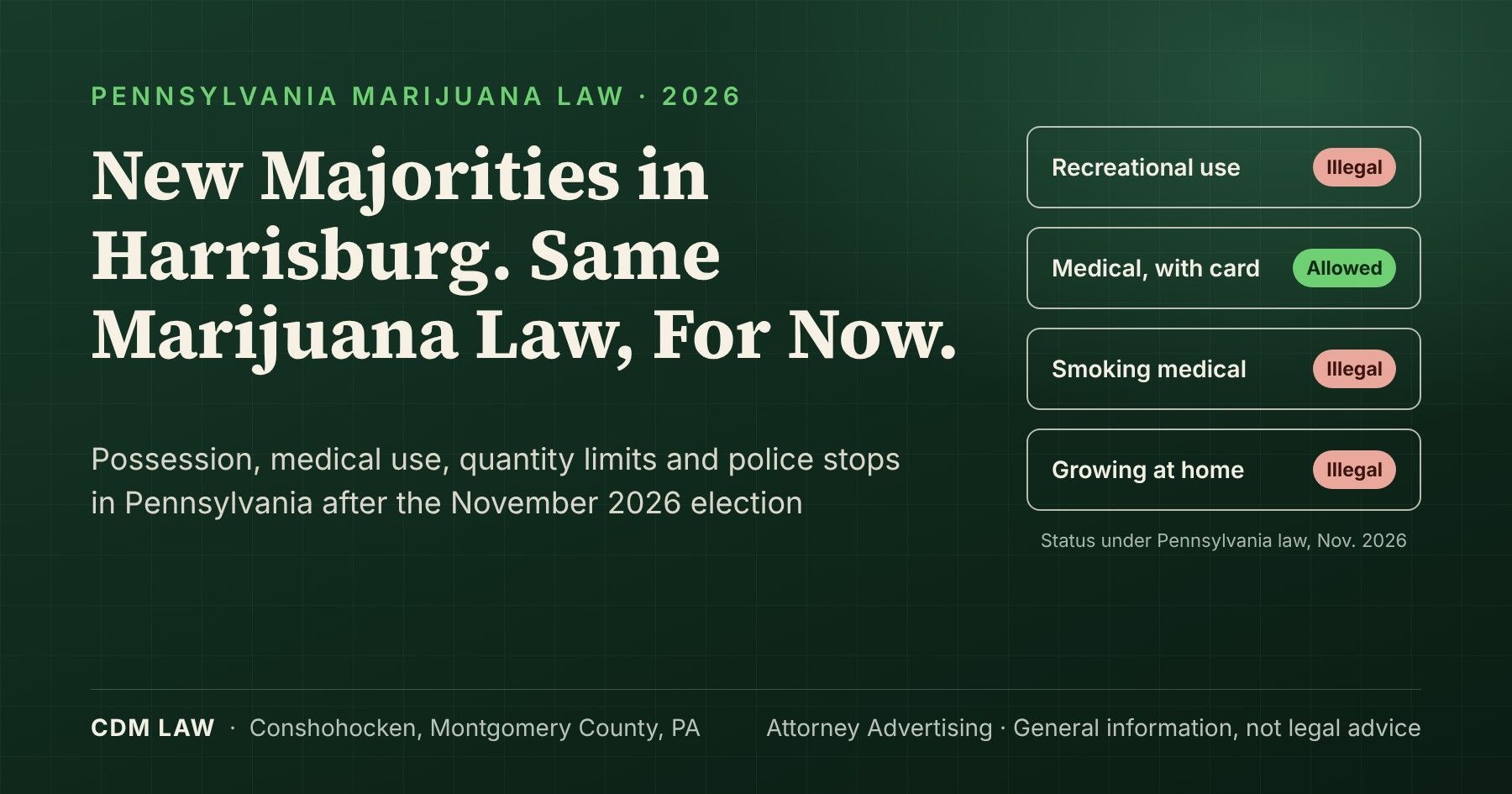
Pennsylvania's cannabis landscape moved a lot this fall. On November 3, 2026, Democrats won control of the state Senate and kept their majority in the House, and Governor Josh Shapiro, who has included adult-use legalization in his budget proposals, was reelected. Supporters say legalization could be on the table in 2027. At the same time, new federal hemp rules began taking effect on November 12, and Philadelphia started enforcing its own limits on intoxicating hemp products the same day.
None of that has changed the law that applies to you today. Recreational marijuana is still illegal in Pennsylvania. Qualifying patients and caregivers may possess medical marijuana, but only within strict rules. Compliance depends on the product, the quantity, the source, the packaging and how the product is used. People continue to be stopped, searched and charged under the current law while the debate in Harrisburg plays out.
This article explains where the law stands as of November 18, 2026, what the recent news does and does not change, and when it makes sense to call a lawyer.
What Changed This Fall, and What Did Not
1. The election opened a path to legalization, but no law has passed
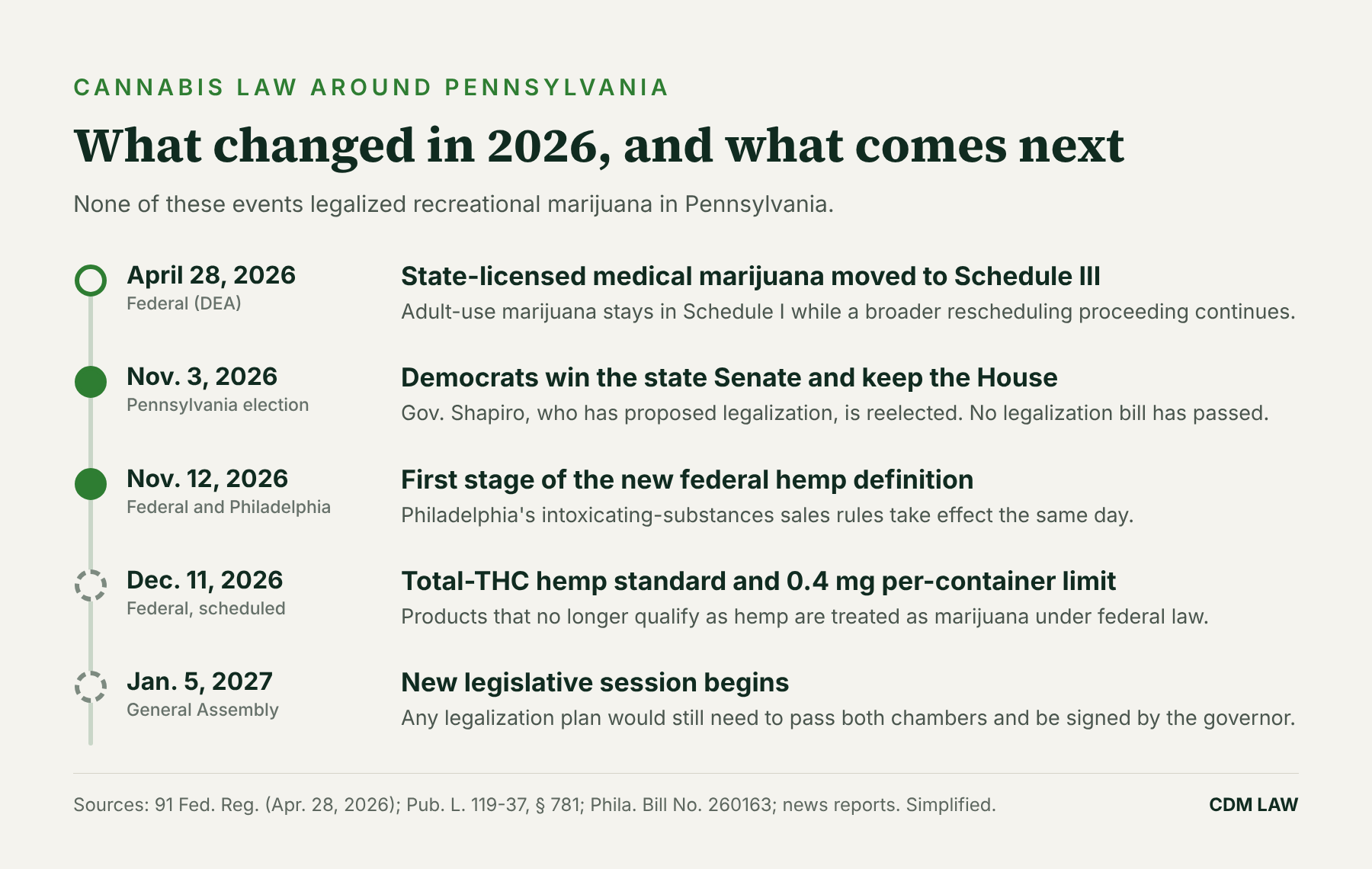
The November 3 election gave Democrats control of the state Senate for the first time in decades, alongside a Democratic House and governor. Bills are already pending. Senate Bill 120, sponsored by Senators Sharif Street and Dan Laughlin, would allow adults 21 and older to possess limited amounts of cannabis and would create an expungement process. The House passed a separate legalization bill built around state-run stores in 2025, but it stalled in the Senate.
The new legislative session begins in January 2027. Any legalization plan would still have to pass both chambers and be signed by the governor, and its details (possession limits, home growing, expungement and effective dates) are not yet known. Until a bill becomes law and takes effect, the rules described below remain in force.
2. Federal rescheduling covers medical marijuana, not recreational use
In a final order published April 28, 2026, the federal government moved FDA-approved marijuana products and marijuana handled under a state medical-marijuana license into Schedule III. Adult-use marijuana was not included and remains in Schedule I while a broader rescheduling proceeding continues. Federal rescheduling does not change Pennsylvania's criminal law, which still lists marihuana as a Schedule I controlled substance.
3. The federal hemp definition is tightening
Congress narrowed the federal definition of hemp in November 2025. The first stage took effect on November 12, 2026, and the remainder, including a total-THC standard and a 0.4-milligram-per-container limit for finished products, is scheduled for December 11, 2026. Products that no longer qualify as hemp are treated as marijuana under federal law. Philadelphia's new intoxicating-substances ordinance also took effect on November 12. We covered both developments in our posts on the federal hemp deadlines and the Philadelphia ordinance.
What Does Pennsylvania Mean by "Marihuana"?
Pennsylvania's Controlled Substance, Drug, Device and Cosmetic Act uses the term "marihuana." The definition generally includes Cannabis sativa L., its seeds, resin extracted from the plant, and compounds, derivatives, mixtures and preparations made from the plant, seeds or resin. 35 P.S. § 780-102.
The definition excludes certain materials, including mature stalks, fiber produced from those stalks, specified seed products and sterilized seeds incapable of germination. It also excludes tetrahydrocannabinols from the definition itself, but Pennsylvania separately classifies tetrahydrocannabinols and marihuana as Schedule I controlled substances. 35 P.S. §§ 780-102, 780-104; 28 Pa. Code § 25.72.
Two important statutory exceptions apply to conduct that complies with Pennsylvania's Medical Marijuana Act or its industrial-hemp laws.
Recreational Possession and Distribution Remain Criminal Offenses
Pennsylvania continues to prohibit unauthorized possession, cultivation, manufacture, delivery and possession with intent to deliver marijuana. 35 P.S. § 780-113.
Possession of 30 grams or less for personal use is a misdemeanor punishable by up to 30 days in jail and a fine of up to $500. The same small-amount provision applies to certain possession with intent to distribute (but not sell) and to distribution without a sale. 35 P.S. § 780-113(a)(31), (g); Commonwealth v. Cassell, 2026 Pa. LEXIS 1843 (Pa. 2026).
Delivery or possession with intent to deliver outside the small-amount provision can carry substantially more serious consequences. Pennsylvania also prohibits possessing drug paraphernalia for unlawful use, and delivering or manufacturing paraphernalia while knowing, or reasonably expected to know, that it will be used unlawfully. 35 P.S. § 780-113(a)(30), (32).
When Is Medical-Marijuana Possession Lawful?
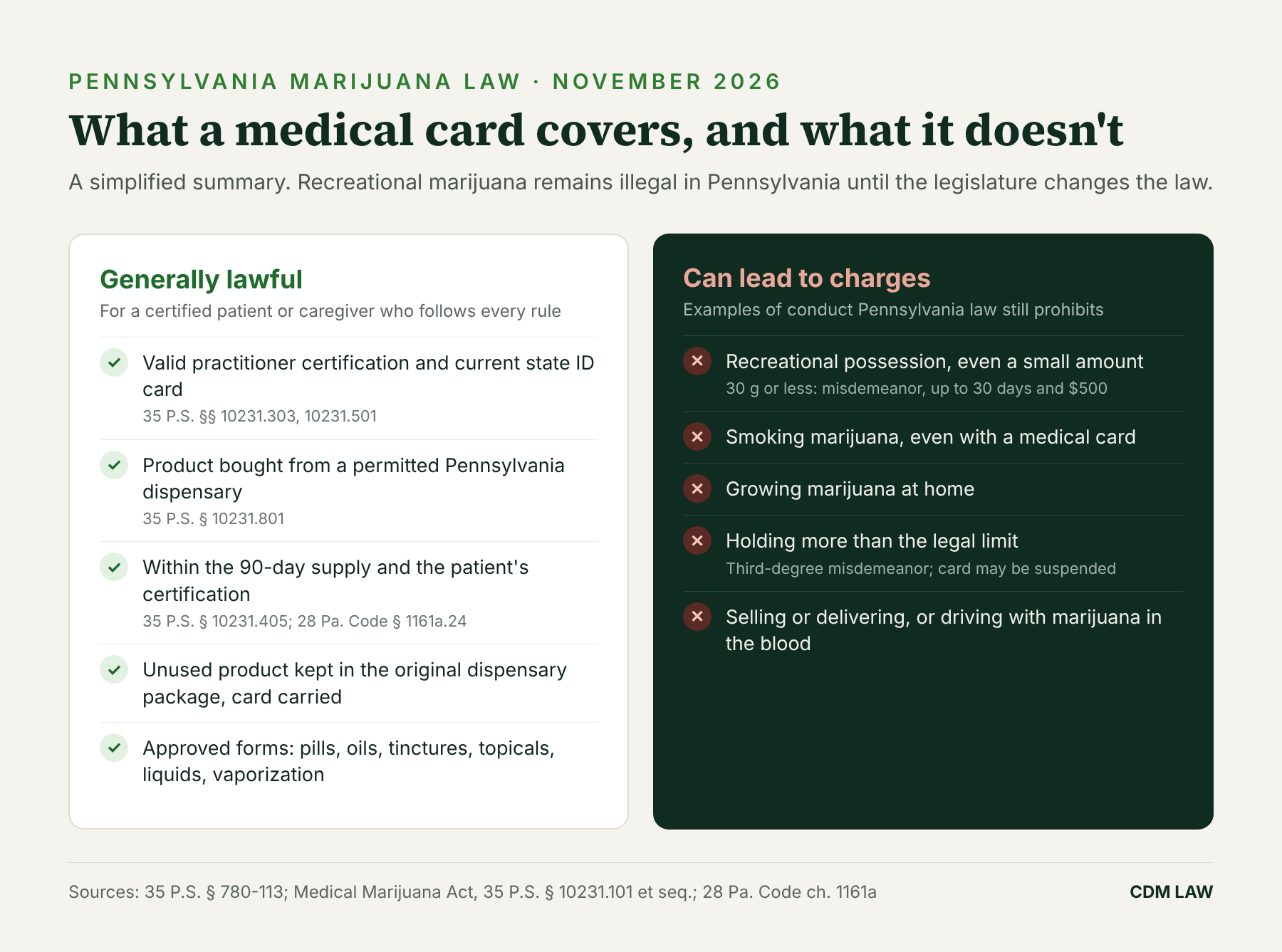
A patient's possession is generally lawful when it qualifies as certified medical use and complies with the Medical Marijuana Act. The patient must have a practitioner's valid certification and a current identification card issued by the Pennsylvania Department of Health. A caregiver who obtains or possesses medical marijuana for a patient must likewise hold the required identification card. 35 P.S. §§ 10231.303, 10231.403, 10231.501.
Lawful possession ordinarily requires the patient or caregiver to:
- obtain the product from a permitted Pennsylvania dispensary;
- present a valid patient or caregiver identification card;
- possess only the form and quantity authorized by the patient's certification and applicable law;
- carry the identification card whenever possessing medical marijuana;
- keep unused medical marijuana in the original package in which the dispensary supplied it; and
- follow restrictions governing use, storage and location.
A dispensary may provide medical marijuana only when the patient's certification remains valid and accessible through the Commonwealth's tracking system. 35 P.S. § 10231.801; 28 Pa. Code § 1191a.31.
Pennsylvania's Medical-Marijuana Quantity Limits
Pennsylvania law generally limits receipt from a dispensary to a 90-day supply of individual doses. A dispensary may not provide more than the quantity permitted by the patient's certification. 35 P.S. §§ 10231.405, 10231.801.
The applicable regulation defines a 90-day supply as 192 medical-marijuana units. Additional product generally may not be dispensed until the patient has exhausted all but a seven-day supply under the certification on file. 28 Pa. Code § 1161a.24.
A patient or caregiver commits a third-degree misdemeanor by intentionally, knowingly or recklessly possessing, storing or maintaining more medical marijuana than legally permitted. 35 P.S. § 10231.1303. An excess-quantity violation can arise when possession exceeds:
- the authorized 90-day supply;
- the amount allowed under a more restrictive patient certification;
- a limitation on the product's form, quantity or active-ingredient percentage; or
- the permitted amount after accounting for an authorized refill or replenishment period.
The Department of Health may also suspend or revoke an identification card for an intentional, knowing or reckless violation of the Medical Marijuana Act. 35 P.S. § 10231.509.
Smoking, Home Cultivation and Other Restrictions
Participation in the medical-marijuana program does not authorize every form of marijuana use.
- Smoking remains illegal. Pennsylvania prohibits smoking medical marijuana, even by a registered patient. Permitted forms include pills, oils, topical preparations, tinctures, liquids and products used through authorized vaporization or nebulization. Dry leaf or plant material may be used only as permitted by Department regulations and may not lawfully be smoked. 35 P.S. §§ 10231.303, 10231.304.
- Patients and caregivers may not grow marijuana at home. Cultivation is limited to properly authorized grower-processors and other statutorily approved organizations. 35 P.S. § 10231.304.
- Unused product must remain in its original package. Medical marijuana must be dispensed in sealed, properly labeled packaging, and unused product must stay in the original dispensary package. 35 P.S. §§ 10231.303, 10231.801.
- Edibles are restricted. A patient or caregiver may incorporate medical marijuana into an edible form to assist the patient's ingestion, but other incorporation into edible products is not authorized. 35 P.S. § 10231.304.
- Driving remains a separate concern. The Medical Marijuana Act's protections do not make every marijuana-related activity lawful. Pennsylvania appellate authority has recognized that the Act does not protect driving with marijuana in the driver's blood merely because the person is a medical-marijuana patient. Commonwealth v. Burkett, 2025 Pa. Super. Unpub. LEXIS 211 (Pa. Super. Ct. 2025).
Industrial Hemp Is Treated Differently
Pennsylvania defines industrial hemp as Cannabis sativa L., or any part of that plant, containing no more than 0.3% delta-9 tetrahydrocannabinol on a dry-weight basis. 3 Pa.C.S. § 702.
Conduct undertaken in compliance with Pennsylvania's industrial-hemp law does not violate the Commonwealth's controlled-substance laws. 3 Pa.C.S. § 706. The exception depends on statutory compliance; labeling a cannabis product "hemp" does not by itself establish that it falls within the exception. That point matters more now that the federal definition is narrowing and Philadelphia has adopted its own sales rules. A product sold legally last year may not qualify today.
Marijuana Odor and Police Investigations
Because Pennsylvania permits some marijuana possession, marijuana odor does not automatically establish unlawful possession. Courts may nevertheless consider odor together with other circumstances when deciding whether police had lawful grounds to detain a person or search for evidence.
In Commonwealth v. Phinn, the Superior Court concluded that reasonable suspicion existed where an officer smelled burnt marijuana, observed conduct consistent with active smoking, saw a smoking instrument, and knew that smoking marijuana remains unlawful even for medical-marijuana patients. Commonwealth v. Kyleel Phinn, 2025 PA Super 262 (Pa. Super. Ct. 2025).
In Commonwealth v. Gould, cannabis odor was accompanied by the driver's admission that he lacked a medical-marijuana card and additional circumstances supporting further investigation and a vehicle-search warrant. Commonwealth v. Gould, 2026 PA Super 180 (Pa. Super. Ct. 2026).
The practical point is that odor remains relevant, but its significance depends on the complete circumstances. Burnt marijuana, apparent smoking, lack of a medical-marijuana card, admissions or other evidence of illegality can materially affect the analysis. Whether a stop or search was lawful is often the most important question in a marijuana case, because evidence obtained through an unlawful search may be challenged in court.
Key Takeaway
Pennsylvania has not legalized recreational marijuana, and the November election did not change that. Lawful medical possession requires a valid certification and identification card, purchase through an authorized dispensary, compliance with quantity and product restrictions, and observance of packaging and use requirements. Smoking medical marijuana, home cultivation, unauthorized distribution and culpable possession above the legal quantity limit remain prohibited. If legalization passes in 2027, it will apply on whatever terms the legislature sets, which may or may not address pending cases or past convictions.
When to Hire CDM LAW
Marijuana cases can look minor, but a conviction can follow you into job applications, professional licensing, immigration matters and future criminal cases. Speaking with a lawyer early gives you the most options. Consider contacting CDM LAW if:
- You have been charged with possession, paraphernalia or possession with intent to deliver. We review the stop, the search, the lab results and the weight, and we evaluate whether diversion such as ARD may be available.
- You are a medical-marijuana patient or caregiver facing charges. Excess-quantity, packaging, smoking and card issues turn on detailed rules, and the facts often matter.
- Your car or home was searched because of marijuana odor. After Phinn and Gould, the full circumstances of the search matter. We assess whether a motion to suppress is appropriate.
- You were arrested for driving under the influence involving marijuana. A medical card is not a defense to a DUI charge by itself. See our Marijuana-Related DUI page.
- You own or operate a smoke shop, hemp business or dispensary-related company. The federal hemp changes and Philadelphia's ordinance create new compliance risk. See our Cannabis Business page.
If you are stopped by police, stay calm and polite, keep your hands visible, and do not physically resist. Drivers must provide a license, registration and proof of insurance when asked, but you may decline to consent to a search and may decline to answer other questions. Ask to speak with a lawyer. If you are a medical-marijuana patient, carry your card and keep products in their original dispensary packaging.
Talk With CDM LAW
CDM LAW represents clients in criminal defense, DUI and cannabis business matters from its office at 815 Fayette Street, Suite 200, Conshohocken, Montgomery County, Pennsylvania. To discuss your situation, call (610) 994-0281 or contact us online. Please do not send confidential information until an attorney-client relationship has been confirmed in writing.
Sources
- Controlled Substance, Drug, Device and Cosmetic Act, 35 P.S. §§ 780-102, 780-104, 780-113; 28 Pa. Code § 25.72
- Medical Marijuana Act, 35 P.S. §§ 10231.303, 10231.304, 10231.403, 10231.405, 10231.501, 10231.509, 10231.801, 10231.1303; 28 Pa. Code §§ 1161a.24, 1191a.31
- Industrial hemp, 3 Pa.C.S. §§ 702, 706
- Commonwealth v. Cassell, 2026 Pa. LEXIS 1843 (Pa. 2026); Commonwealth v. Kyleel Phinn, 2025 PA Super 262; Commonwealth v. Gould, 2026 PA Super 180; Commonwealth v. Burkett, 2025 Pa. Super. Unpub. LEXIS 211
- Marijuana Moment, "Pennsylvania Is Teed Up To Finally Legalize Marijuana As Democrats Claim Majority In State Senate" (Nov. 4, 2026)
- WHYY, "A 'trifecta': Pennsylvania Democrats preview policy plans after winning control in Harrisburg" (Nov. 4, 2026)
- Drug Enforcement Administration, final order, 91 Fed. Reg. (Apr. 28, 2026)
- Regulatory Oversight, "Pending Marijuana Rescheduling Put on Hold" (Oct. 2026)
- CDM LAW, "Pennsylvania Hemp Ban Update: Nov. 12 & Dec. 11 Deadlines"
- CDM LAW, "Philadelphia's New Intoxicating Substances Ordinance"
Legal Disclaimer
Attorney Advertising. This article is provided by CDM LAW for general informational purposes only. It is not legal advice, and it reflects the law as of November 18, 2026. Pennsylvania's legislature may change these rules, and the outcome of any case depends on its specific facts. Christopher D. Mandracchia, Esq., of CDM LAW, Conshohocken, Pennsylvania, is responsible for the content of this article.
Reading this article or contacting CDM LAW through this website does not create an attorney-client relationship. You should consult a qualified attorney about your specific situation before acting on any information here. Prior results do not guarantee a similar outcome. No representation is made that any lawyer at CDM LAW is certified as a specialist in any field of law. The graphics in this article are original illustrations created for informational purposes.