
When Banks Get Hacked in Pennsylvania: Recovering Stolen Funds, Breach-Notification Rights and Business Litigation
Recent breaches at Pennsylvania banks and their vendors show how fast customer data can be exposed. Here is how federal law protects your money, what Pennsylvania's notice law requires, and when a breach becomes a lawsuit.
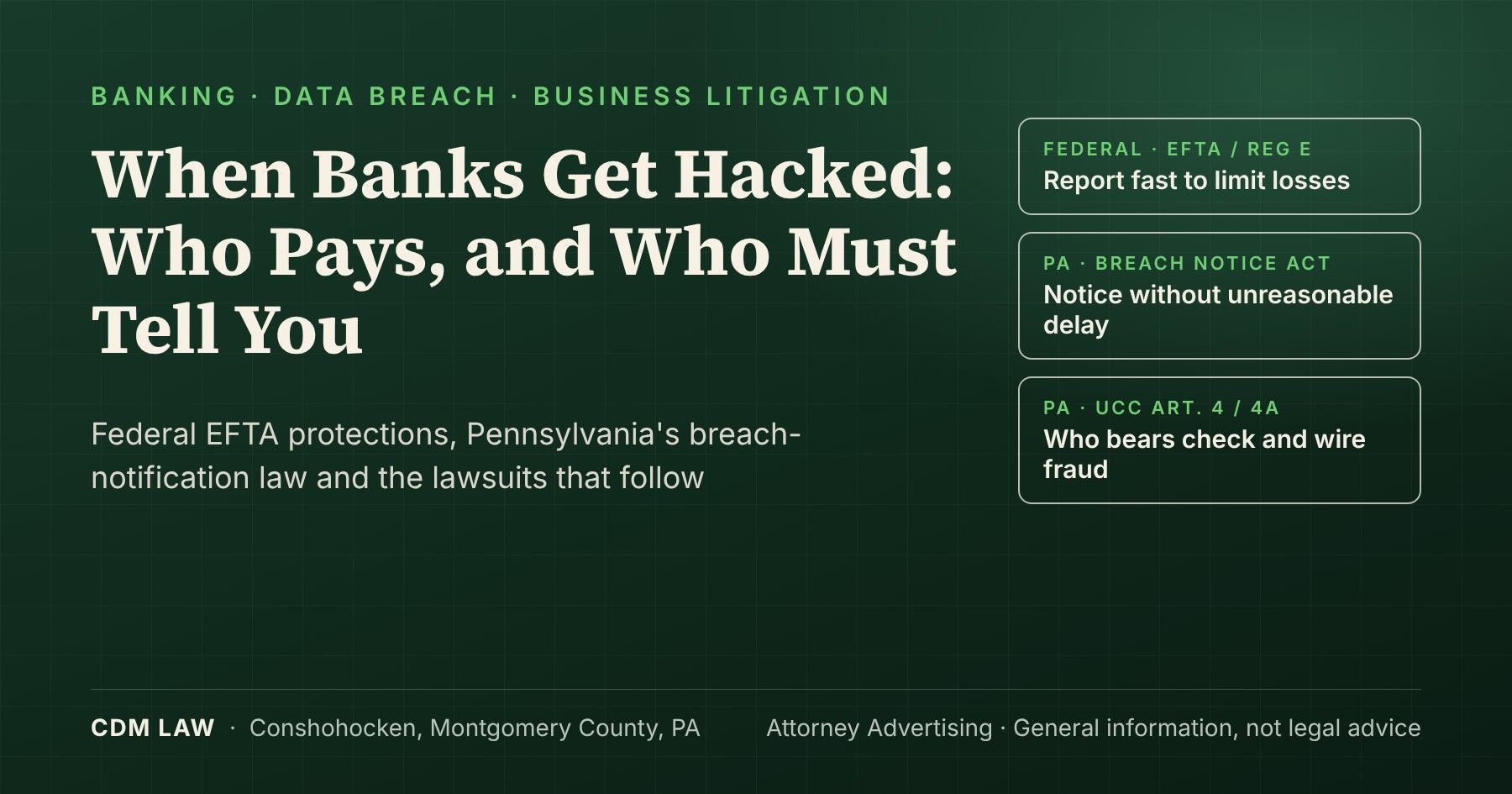
Bank cyber incidents are no longer rare headlines. In May 2026, Pennsylvania-based Community Bank, a subsidiary of CB Financial Services, told the SEC that customer names, Social Security numbers and dates of birth had been placed into an unauthorized AI application, and that it was notifying customers and regulators. In October 2026, American Banker reported that a breach at the auditing firm Mercadien reached customers of at least nine banks and credit unions, including more than 83,000 people tied to Pennsylvania's Orrstown Bank, and that many institutions learned their customers were affected six to nine months after the intrusion was found. Lawsuits over that breach have been consolidated in federal court in New Jersey.
When a bank or one of its vendors is hacked, customers usually ask two questions: Can I get my money back? and Who has to tell me what happened? Businesses ask a third: Who bears the loss, and can we sue? The answers depend on what kind of transaction was involved, how quickly the problem was reported, and which law applies. This article walks through the federal protections for consumer accounts, Pennsylvania's Breach of Personal Information Notification Act, and the litigation options that follow a bank breach.
Federal Protection for Consumer Accounts: The EFTA and Regulation E
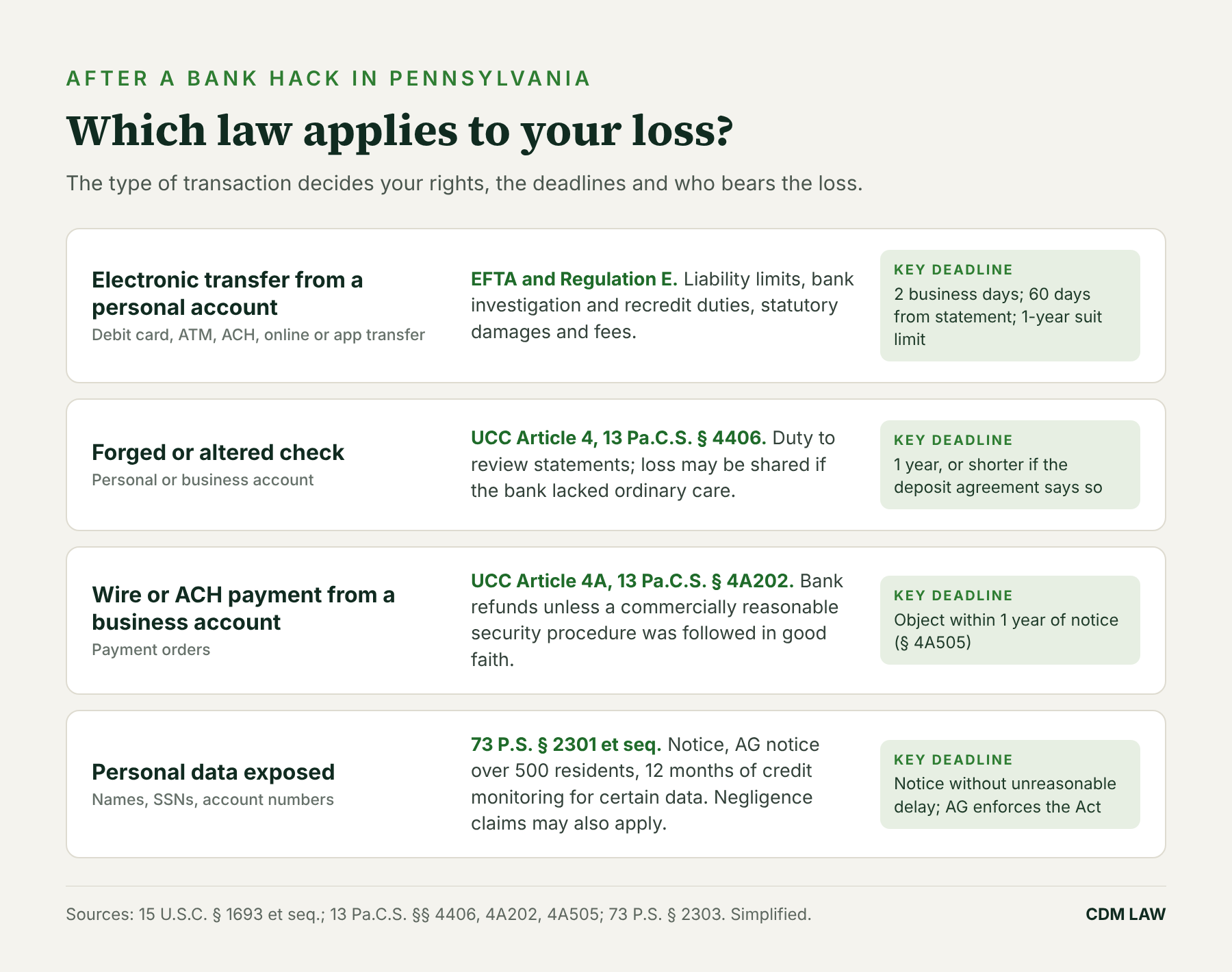
The Electronic Fund Transfer Act (EFTA), 15 U.S.C. § 1693 et seq., and its implementing rule, Regulation E, 12 C.F.R. Part 1005, protect consumers when money leaves a personal checking, savings or other asset account through an electronic transfer. Covered transfers include debit-card purchases, ATM withdrawals, ACH debits, and transfers made by phone or online. 15 U.S.C. § 1693a.
An unauthorized electronic fund transfer is one initiated by someone other than the consumer, without actual authority, from which the consumer receives no benefit. The definition excludes transfers by a person the consumer gave the card, code or login to (until the consumer tells the bank that person's authority has ended), transfers made with the consumer's fraudulent participation, and errors by the bank itself. 15 U.S.C. § 1693a; 12 C.F.R. § 1005.2. A hacker who uses stolen online-banking credentials to drain a personal account will often fall within the definition. A relative or acquaintance who was once given the password may not.
The EFTA covers consumer asset accounts, not credit cards or business accounts. In Hatchigian v. Capital One, N.A., 2024 U.S. Dist. LEXIS 215810 (E.D. Pa. 2024), the court dismissed an EFTA claim because it arose from a credit-card transaction rather than an electronic transfer from a covered account.
How much can a consumer lose?
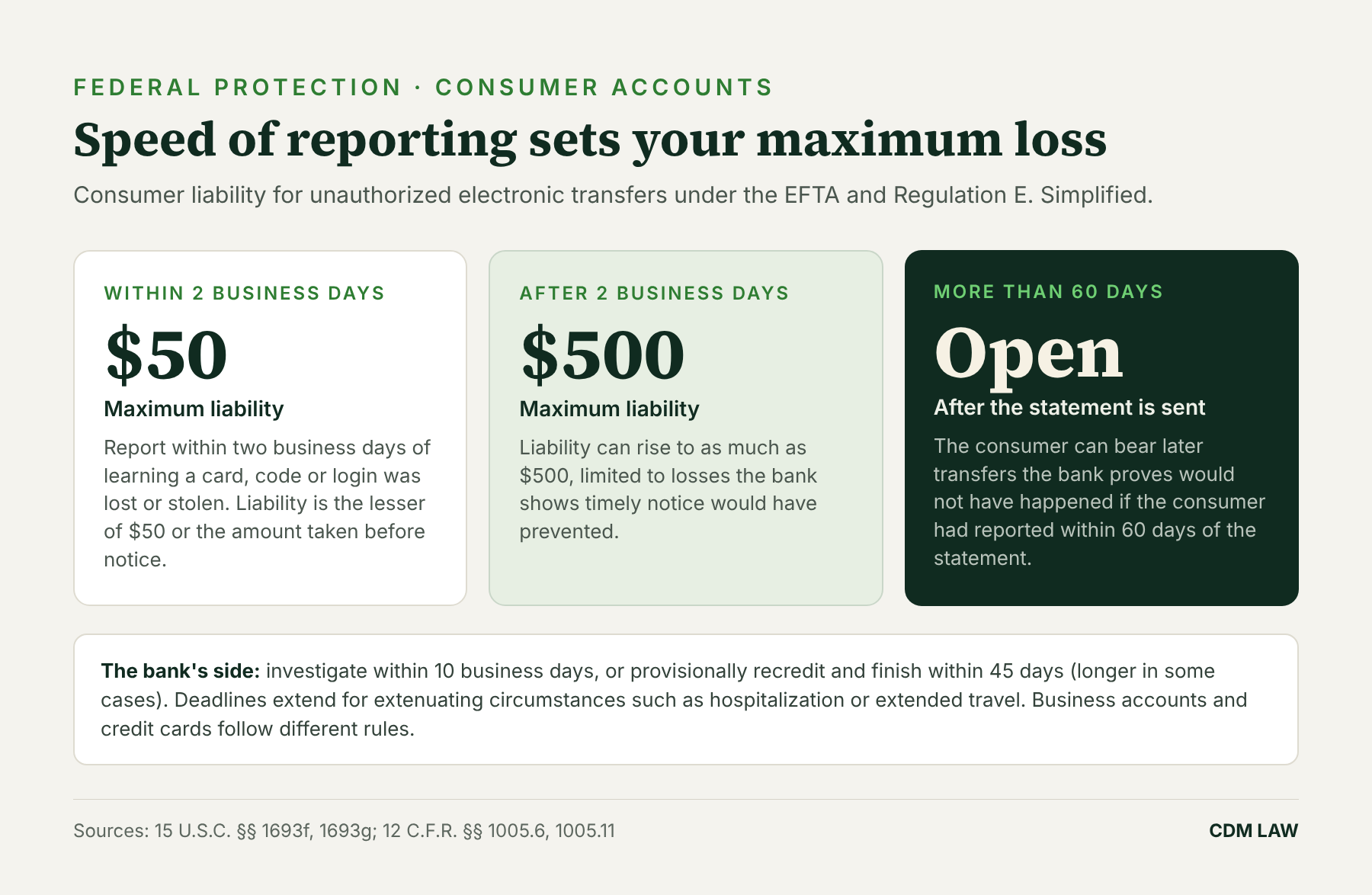
Except as the statute provides, a consumer bears no liability for an unauthorized electronic transfer. 15 U.S.C. § 1693g. When liability does apply, it depends on how fast the consumer acts:
- Report within two business days of learning that a card, code or login was lost or stolen, and liability is capped at the lesser of $50 or the amount taken before notice.
- Report later, and liability can rise to as much as $500, but only for losses the bank shows timely notice would have prevented.
- Report within 60 days after the bank sends a statement showing the unauthorized transfer. After that, the consumer can be responsible for later transfers the bank proves would not have happened with timely notice.
These deadlines must be extended for extenuating circumstances such as extended travel or hospitalization. 12 C.F.R. § 1005.6. Delay can be decisive: in Binns v. BB&T Bank, 377 F. Supp. 3d 487 (E.D. Pa. 2019), the bank won summary judgment because the customer did not report in time, timely notice would have stopped the losses, and the EFTA's one-year limitations period barred older transactions.
What the bank must do
An unauthorized transfer is an "error" that triggers the bank's investigation duties. After timely notice (within 60 days of the statement), the bank generally must investigate and report its results within ten business days. Alternatively, it may provisionally recredit the disputed amount within ten business days and take up to 45 days to finish its investigation, with longer periods for new accounts, point-of-sale debit transactions and foreign-initiated transfers. If the bank finds no error, it must explain why and, on request, provide the documents it relied on. 15 U.S.C. § 1693f; 12 C.F.R. § 1005.11.
If a bank fails to comply, the consumer may recover actual damages, statutory damages of $100 to $1,000 in an individual action, costs and reasonable attorney's fees. 15 U.S.C. § 1693m. Treble damages are available when a bank fails to provisionally recredit without a good-faith investigation or a reasonable basis, or knowingly and willfully denies an error the evidence did not support. 15 U.S.C. § 1693f(e). Courts expect a complaint to plead the specific coverage, error and statutory failure. Leung v. JPMorgan Chase & Co., 2023 U.S. Dist. LEXIS 252306 (E.D. Pa. 2023).
Pennsylvania's Breach of Personal Information Notification Act
Pennsylvania's Breach of Personal Information Notification Act, 73 P.S. § 2301 et seq., requires any entity that maintains, stores or manages computerized personal information to notify Pennsylvania residents when their unencrypted and unredacted personal information was, or is reasonably believed to have been, accessed and acquired by an unauthorized person. Notice must be given without unreasonable delay, allowing only the time needed to determine the scope of the breach and restore the system. 73 P.S. § 2303.
Amendments in Act 33 of 2024, effective September 26, 2024, added three obligations businesses frequently overlook:
- Attorney General notice. When more than 500 Pennsylvania residents must be notified, the entity must notify the Office of Attorney General at the same time.
- Credit monitoring. When the breach involves a Social Security number, bank account number, or driver's license or state ID number, the entity must offer 12 months of free credit monitoring and access to one independent credit report.
- Credit bureau notice. The threshold for notifying the nationwide consumer reporting agencies dropped from 1,000 to 500 people.
Vendors matter too. A vendor that maintains data for another entity must notify that entity after discovering a breach, but the entity that owns the relationship remains responsible for the statute's determinations and customer notices. 73 P.S. § 2303. The Mercadien incident shows why this rule has teeth: an auditor that a bank stopped using years ago may still hold its customers' data.
A financial institution is deemed compliant if it follows the federal Interagency Guidance on Response Programs for Unauthorized Access to Customer Information and Customer Notice. 73 P.S. § 2307. Separately, federal banking regulators require banks to notify their primary regulator of significant computer-security incidents within 36 hours.
The Act has limits for individuals. A violation is treated as an unfair or deceptive practice, but the Attorney General has exclusive authority to enforce it. 73 P.S. § 2308. The statute itself does not give customers a private lawsuit, and it does not decide whether a bank must reimburse stolen money. That question is governed by the EFTA, Regulation E and the Uniform Commercial Code.
When a Breach Becomes Business Litigation
For businesses, the rules shift. Commercial accounts are generally outside the EFTA, so losses are allocated under Pennsylvania's Uniform Commercial Code and the account agreement.
Wire and ACH fraud against business accounts
Under UCC Article 4A, a bank generally must refund an unauthorized payment order. The risk shifts to the customer, however, if the parties agreed to a security procedure, the procedure was commercially reasonable, and the bank accepted the order in good faith and in compliance with that procedure and any written customer restrictions. 13 Pa.C.S. § 4A202; Conductive Technologies, Inc. v. PNC Bank, N.A., 737 F. Supp. 3d 270 (M.D. Pa. 2024). A customer can still recover by proving the fraud did not originate with its own employees, systems or information. A customer who receives notice of a payment order generally has one year to object. 13 Pa.C.S. § 4A505. In practice, these cases turn on the security procedures in the treasury-management agreement, the bank's fraud-monitoring records and the company's own controls.
Forged and altered checks
Check fraud falls under UCC Article 4, not the EFTA. Customers must review statements with reasonable promptness, and a customer who does not report an unauthorized signature or alteration within one year is barred from asserting it against the bank. 13 Pa.C.S. § 4406; Estate of Hollywood v. First National Bank of Palmerton, 2004 PA Super 321. Deposit agreements may shorten that period, and the Superior Court has cited authority treating a 30-day contractual notice window as not manifestly unreasonable. Levy Baldante Finney & Rubenstein, P.C. v. Wells Fargo Bank, N.A., 2018 Pa. Super. Unpub. LEXIS 470. If the bank failed to exercise ordinary care, the loss may be shared; if it did not act in good faith, the bar does not apply.
Negligence, contract and consumer-protection claims
Pennsylvania courts recognize additional theories after a breach:
- Negligence. In Dittman v. UPMC, 649 Pa. 496, 196 A.3d 1036 (2018), the Pennsylvania Supreme Court held that an employer that collected and stored employees' sensitive data on an internet-accessible system owed a duty of reasonable care to protect it, even though criminals carried out the theft.
- Damages. In Volio v. Sugarhouse HSP Gaming, L.P., 2026 U.S. Dist. LEXIS 177058 (E.D. Pa. 2026), the court held that time and money spent on monitoring, credit freezes and identity protection, along with actual misuse, were cognizable damages at the pleading stage.
- Confidentiality. Pennsylvania recognizes an implied contractual duty of a bank to keep account information confidential. McGuire v. Shubert, 722 A.2d 1087 (Pa. Super. 1998).
- Consumer protection. The Unfair Trade Practices and Consumer Protection Law allows consumers to recover actual damages or $100, up to triple damages and attorney fees, but deceptive-conduct claims require proof of justifiable reliance. 73 P.S. § 201-9.2; Kirwin v. Sussman Automotive, 2016 PA Super 222.
For companies that hold customer data, the same principles cut the other way. A business that suffers a breach may face notice obligations, regulatory inquiries and class claims, and may need to pursue its own vendor for indemnification or breach of contract.
What to Do After a Bank Hack
- Call the bank immediately, then confirm in writing with your name, account number, the amounts in dispute and why you believe they are unauthorized. Keep a copy and note the date and the person you spoke with.
- Review every statement and report new problems well within 60 days for electronic transfers and promptly for checks. Check your deposit agreement for shorter deadlines.
- Change passwords and security answers, especially for any other account that uses the same login, which Pennsylvania law allows breach notices to recommend.
- Enroll in offered credit monitoring, consider a credit freeze, and keep receipts and time records for the steps you take.
- Preserve the bank's responses, including any denial letter. You are entitled to request the documents the bank relied on.
- For businesses, pull the treasury-management agreement and security-procedure documents, notify your insurer, and review vendor contracts for notice and indemnity terms.
When to Hire CDM LAW
Contact a lawyer if your bank denies a claim, misses its investigation deadlines, reverses a provisional credit, or tells you a loss is your responsibility; if a wire or ACH transfer drained a business account; or if your company has experienced a breach and must decide whom to notify and who should pay. Early advice can preserve claims that short notice periods and limitations deadlines would otherwise cut off.
CDM LAW handles business litigation and civil litigation for Pennsylvania individuals and companies. We can review your account agreement and bank correspondence, press EFTA and UCC claims, and advise businesses on breach-response obligations and vendor disputes.
Talk With CDM LAW
CDM LAW serves clients from its office at 815 Fayette Street, Suite 200, Conshohocken, Montgomery County, Pennsylvania. To discuss your situation, call (610) 994-0281 or contact us online. Please do not send confidential information until an attorney-client relationship has been confirmed in writing.
Sources
- Electronic Fund Transfer Act, 15 U.S.C. §§ 1693a, 1693f, 1693g, 1693m; Regulation E, 12 C.F.R. §§ 1005.2, 1005.6, 1005.11
- Breach of Personal Information Notification Act, 73 P.S. §§ 2303, 2307, 2308, as amended by Act 33 of 2024
- 13 Pa.C.S. §§ 3406, 4406, 4A202, 4A505; 73 P.S. § 201-9.2
- Hatchigian v. Capital One, N.A., 2024 U.S. Dist. LEXIS 215810 (E.D. Pa. 2024); Leung v. JPMorgan Chase & Co., 2023 U.S. Dist. LEXIS 252306 (E.D. Pa. 2023); Binns v. BB&T Bank, 377 F. Supp. 3d 487 (E.D. Pa. 2019); Conductive Technologies, Inc. v. PNC Bank, N.A., 737 F. Supp. 3d 270 (M.D. Pa. 2024)
- Dittman v. UPMC, 649 Pa. 496, 196 A.3d 1036 (2018); Volio v. Sugarhouse HSP Gaming, L.P., 2026 U.S. Dist. LEXIS 177058 (E.D. Pa. 2026); McGuire v. Shubert, 722 A.2d 1087 (Pa. Super. 1998); Estate of Hollywood v. First National Bank of Palmerton, 2004 PA Super 321; Levy Baldante Finney & Rubenstein, P.C. v. Wells Fargo Bank, N.A., 2018 Pa. Super. Unpub. LEXIS 470; Kirwin v. Sussman Automotive, 2016 PA Super 222
- Wilson Sonsini, "Shadow AI Triggers First SEC Form 8-K for Unauthorized AI Use" (May 28, 2026)
- American Banker, report on auditor breach affecting at least nine banks and credit unions (Oct. 8, 2026)
- Constangy, "Pennsylvania's amendments to data breach notification law take effect"
Legal Disclaimer
Attorney Advertising. This article is provided by CDM LAW for general informational purposes only. It is not legal advice, and it reflects the law as of November 18, 2026. Descriptions of reported incidents are based on public filings and news reports and are not findings of wrongdoing by any institution. The outcome of any matter depends on its specific facts and agreements. Christopher D. Mandracchia, Esq., of CDM LAW, Conshohocken, Pennsylvania, is responsible for the content of this article.
Reading this article or contacting CDM LAW through this website does not create an attorney-client relationship. You should consult a qualified attorney about your specific situation before acting on any information here. Prior results do not guarantee a similar outcome. No representation is made that any lawyer at CDM LAW is certified as a specialist in any field of law. The graphics in this article are original illustrations created for informational purposes.