
Philadelphia's New Intoxicating Substances Ordinance: What Smoke Shops Need to Know About Pennsylvania Hemp Laws
Bill No. 260163's bans on hemp THC and kratom products apply now. The retailer permit waits on city regulations.
As of November 12, 2026, Philadelphia smoke shops face a new set of city rules on hemp-derived THC and kratom. City Council Bill No. 260163, the city's intoxicating substances ordinance, is now in effect. Its sales prohibitions, 21-and-over age limit and daily fines apply today.
There is a catch that every shop owner should understand. The ordinance also creates an Intoxicating Substance Retailer permit, the path for lawful sales of qualifying products. That permit does not take effect until the city issues regulations, and as of this writing those regulations do not appear to have been announced. The prohibitions are live; the licensing path is not.
At the same time, federal hemp law is changing. A new federal definition of "hemp" starts phasing in on November 12, with broader limits scheduled for December 11, 2026. Pennsylvania, for its part, still has no comprehensive state law regulating intoxicating hemp products.
This guide explains, in plain English, how these layers fit together for Philadelphia smoke shops and what owners can do now.
Three Layers of Law: Federal, Pennsylvania and Philadelphia
A Philadelphia smoke shop selling hemp products now answers to three overlapping sets of rules, and the strictest one controls in practice.
Federal: hemp is being redefined
Congress rewrote the federal definition of hemp in P.L. 119-37, enacted November 12, 2025. According to the Congressional Research Service, the new definition:
- Measures the 0.3% limit by total THC, not just delta-9 THC, which captures THCA.
- Excludes final hemp-derived cannabinoid products containing more than 0.4 milligrams of total THC per container.
- Excludes cannabinoids the cannabis plant cannot naturally produce, and naturally occurring cannabinoids that were synthesized or manufactured outside the plant.
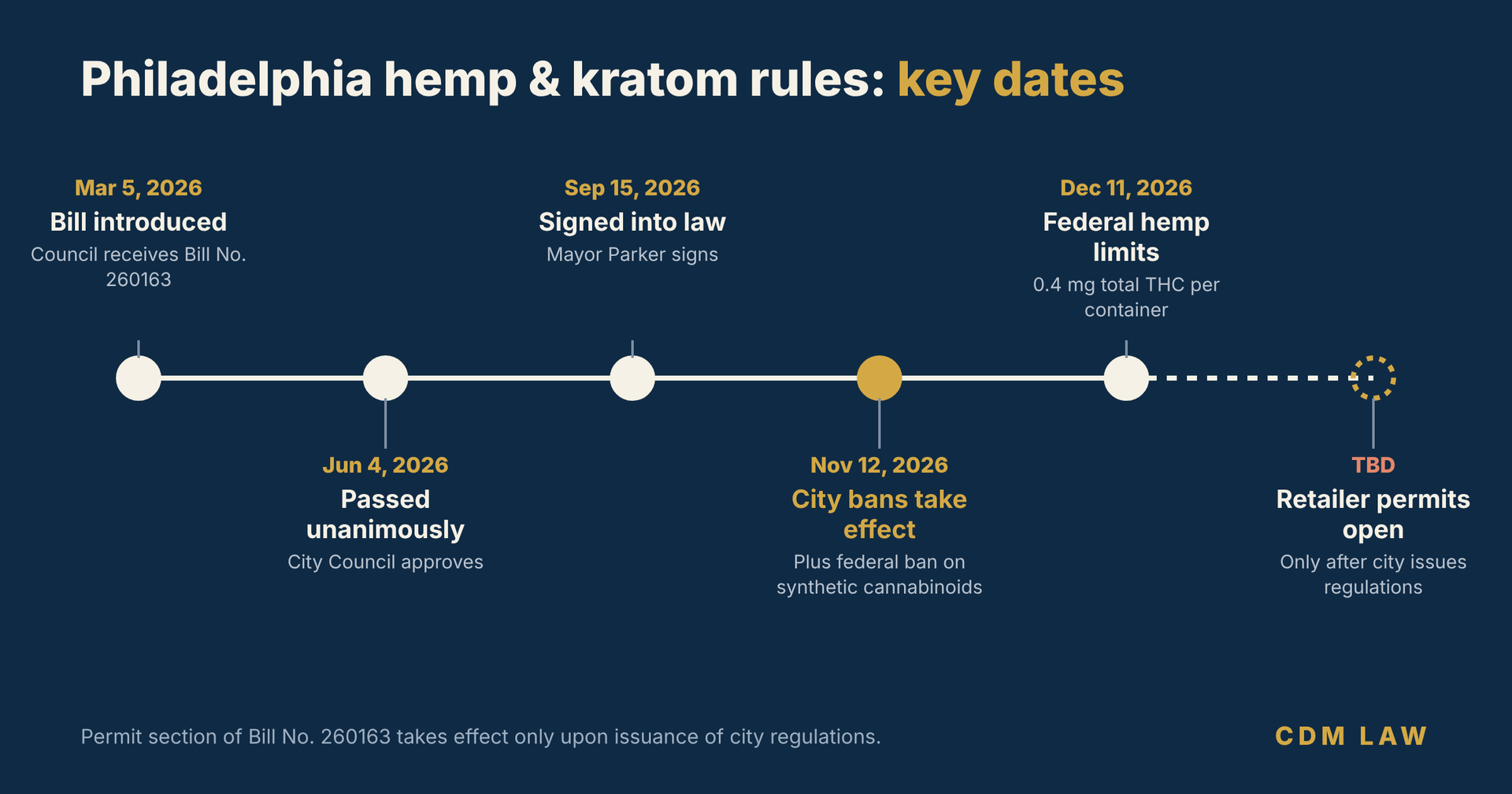
In September 2026, Congress delayed most of the change. H.R. 6500, signed September 2, 2026, moved the start date for naturally derived hemp-THC products to December 11, 2026. Synthetic cannabinoids stayed on the original November 12, 2026 timeline.
Pennsylvania: no comprehensive hemp-THC statute yet
Pennsylvania regulates hemp growers and processors through the Department of Agriculture, but it has not enacted a framework for intoxicating hemp products. Adult-use marijuana remains illegal; marijuana is available only through the state medical program.
- Food and drinks: Spotlight PA reports that current state law bars selling food and beverages with any level of THC, and the Shapiro administration has said no new hemp rules are in progress at the Department of Agriculture.
- Pending proposals: Sen. Dawn Keefer has circulated a cosponsorship memo for a "Pennsylvania Hemp and Cannabinoid Act" with registration, testing, labeling and 21+ sales. A separate bill from Sen. Dan Laughlin that would create a Cannabis Control Board and restrict most hemp THC products was defeated on the Senate floor in June 2026 but remains pending reconsideration.
Because there is no state framework, local governments like Philadelphia have stepped in.
Philadelphia: the city's own rules
Philadelphia already requires a Tobacco Retailer Permit under Philadelphia Code § 9-631 for tobacco and vape sales. Bill No. 260163 adds a separate set of rules for hemp-derived and kratom products, discussed next.
What Bill No. 260163 Does
Bill No. 260163, sponsored by Majority Leader Katherine Gilmore Richardson, amends Title 9 of the Philadelphia Code to regulate the sale of "intoxicating substances," a term that covers hemp-derived cannabinoid products and kratom. Council introduced it March 5, 2026, passed it unanimously on June 4, and Mayor Cherelle Parker signed it on September 15.
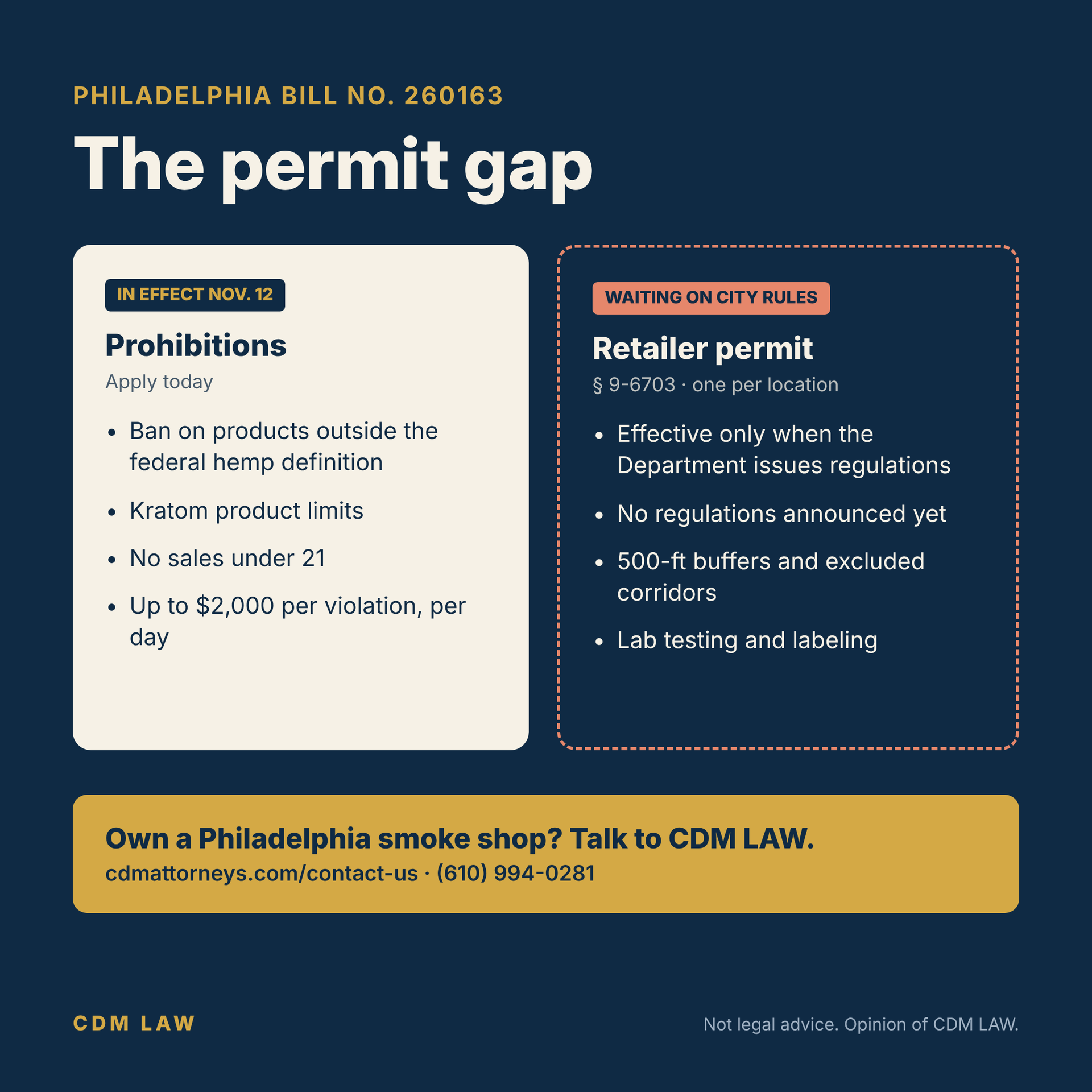
The provisions in effect as of November 12, 2026, as reported by FOX 29 and the Philadelphia Inquirer:
- Hemp products: Bans the sale of any product that federal law excludes from the definition of hemp. The city code sets no THC number of its own; it borrows the federal one.
- FDA status: Bars intoxicating substances that are not approved as a dietary supplement or safe food additive, or that lack an approved FDA application.
- Kratom: Bans adulterated kratom products, extracts with excess solvent residue, products above 2% 7-hydroxymitragynine as a share of total alkaloids, and synthetic versions.
- Age: No sales to anyone under 21.
- Penalties: Class III offense, up to $2,000 per violation. Each day a violation continues is a separate offense.
- Grace period: None reported.
A companion bill passed the same day lets the city pursue commercial landlords who knowingly rent to unpermitted smoke shops. Property owners should treat compliance as a shared concern with their tenants.
Why the date matters. Because the city ban tracks federal law, its reach shifts as the federal definition phases in. On November 12, the federal exclusion for synthetic cannabinoids is in effect; the 0.4 mg-per-container limit for naturally derived products is scheduled for December 11. Which products are prohibited in the city between those dates is an open question that shop owners should review product by product with counsel.
The Permit Gap: Bans Now, Licensing Later
In CDM LAW's view, the most important practical issue for shop owners is timing. Section 9-6703 creates an Intoxicating Substance Retailer permit, required for each retail location. But Section 2 of the bill says that section takes effect "upon the issuance of regulations by the Department," not on November 12.
That leaves a gap. The prohibitions apply now, while the licensing path depends on rules that do not appear to have been announced. A shop cannot apply for a permit that the city is not yet issuing.
What the permit will require once it is live, as reported:
- Scope: One permit per location; fixed storefronts only.
- Fees: $300 application, $300 renewal, $50 late renewal.
- Buffer zones: Not within 500 feet of a school, public playground, park, swimming pool, recreation center, library or child care facility.
- Excluded corridors: About 180 commercial corridors and business improvement districts, including parts of Center City, Old City, Kensington Avenue, Frankford Avenue, 52nd Street, Germantown Avenue and much of the Northeast.
- Testing and labels: Products tested by a federally registered lab licensed in Pennsylvania and labeled to show they passed.
What the gap means for you
- Location may decide eligibility. If your store sits inside a buffer zone or an excluded corridor, you may never qualify for the permit, whatever the regulations say. Map your address now.
- No permit is not a defense. The ordinance's sales bans and daily fines apply whether or not the city has started issuing permits.
- Watch for the regulations. When the city publishes them, they will set the application process, timelines and details that the ordinance leaves open. Early applicants are usually better positioned.
- Enforcement details are unclear. Public reporting has not identified how the city will inspect or respond to complaints, or how many businesses are affected.
Seven Steps Philadelphia Smoke Shops Can Take Now
- Audit your shelves. List every hemp-derived and kratom product, with its certificate of analysis, total THC per container and cannabinoid source (natural or synthesized).
- Pull non-compliant inventory. Set aside products that appear to fall outside the federal hemp definition or the city's kratom limits. Document what you removed and when.
- Tighten ID checks. Card every customer for intoxicating-substance purchases; the age is 21, with no exceptions. Train staff and keep a written policy.
- Check your location. Measure your distance from schools, playgrounds, parks, pools, rec centers, libraries and child care facilities, and confirm whether your block is in an excluded corridor.
- Confirm your other permits. Make sure your Commercial Activity License and Tobacco Retailer Permit are current and match what you actually sell.
- Talk to your landlord. Under the companion landlord bill, property owners have their own exposure. A clear compliance plan protects the lease.
- Prepare for the permit. Gather lab partners, labeling, floor plans and ownership records so you can apply quickly once regulations are issued.
If you have already received a notice or citation, speak with a lawyer before responding. Each day of a continuing violation can be a separate $2,000 offense.
Frequently Asked Questions
Is delta-8 or THCA legal to sell in Philadelphia?
It depends on the specific product and the date. The city bans what federal law excludes from "hemp," and the federal definition now counts total THC and excludes synthesized cannabinoids. Many delta-8, THCA and similar products are likely to fall outside the definition once the federal limits fully apply on December 11, 2026.
When can I apply for an Intoxicating Substance Retailer permit?
Not yet. The permit section takes effect only after the city issues regulations, which do not appear to have been announced.
Does my Tobacco Retailer Permit cover hemp or kratom?
No. The tobacco permit under § 9-631 covers tobacco and vape products. Hemp-derived and kratom products fall under the new ordinance.
What are the fines?
Up to $2,000 per violation, and each day a violation continues counts as a separate offense.
Is kratom banned in Philadelphia?
The ordinance bans several categories of kratom products and bars intoxicating substances lacking FDA approval or recognition. Industry groups argue this effectively ends natural-leaf kratom sales; how the city applies it remains to be seen.
Does Pennsylvania law override Philadelphia's ordinance?
Pennsylvania has no comprehensive state law on intoxicating hemp products, so the city ordinance and federal law currently set the main rules. That could change if the General Assembly passes a statewide framework.
Talk to CDM LAW About Your Smoke Shop
CDM LAW is a Pennsylvania law firm that advises cannabis and hemp businesses, retailers and property owners. We can help you review your product mix, assess your location for permit eligibility, respond to city notices, and prepare for the Intoxicating Substance Retailer permit once regulations are issued.
Contact CDM LAW to discuss your smoke shop business needs →
Or call (610) 994-0281, Monday through Friday, 8:30 a.m. to 5:30 p.m.
Sources
- Philadelphia City Council, Bill No. 260163
- FOX 29 via Yahoo News, "Philadelphia's kratom ban, hemp restrictions take effect Thursday" (Nov. 11, 2026)
- Philadelphia Inquirer, Council passes smoke shop and kratom bills (June 5, 2026)
- Philadelphia Inquirer, Council seeks new license system for smoke shops (Mar. 5, 2026)
- Philadelphia City Council press release on the intoxicating substances bills
- Congressional Research Service, Change to Federal Definition of Hemp (IN12620)
- Foley Hoag, A Temporary Reprieve for Hemp-THC Products (Sept. 2026)
- Spotlight PA, Where Shapiro and Garrity stand on marijuana (July 8, 2026)
- Marijuana Moment, Pennsylvania senator announces hemp THC bill (Sept. 28, 2026)
- City of Philadelphia, Get a Tobacco Retailer Permit
Legal Disclaimer
Attorney Advertising. This article is provided by CDM LAW for general informational purposes only. It is not legal advice, and it reflects the opinions of CDM LAW based on publicly available information as of November 12, 2026. Laws, regulations and enforcement practices in this area are changing quickly, and the city's permit regulations had not been published when this article was written.
Reading this article or contacting CDM LAW through this website does not create an attorney-client relationship. Do not send confidential information until an engagement has been confirmed in writing. You should consult a qualified attorney about your specific situation before acting on any information here. Prior results do not guarantee a similar outcome. CDM LAW does not promote or encourage the sale or use of any controlled or intoxicating substance, and nothing in this article should be read as an opinion that any specific product is lawful.