
Violated ARD on a Pennsylvania DUI? What the Supreme Court's 2026 Worzel Decision Means
On October 1, 2026, the Pennsylvania Supreme Court held that a DUI ARD violation does not automatically end the program. The trial judge decides.
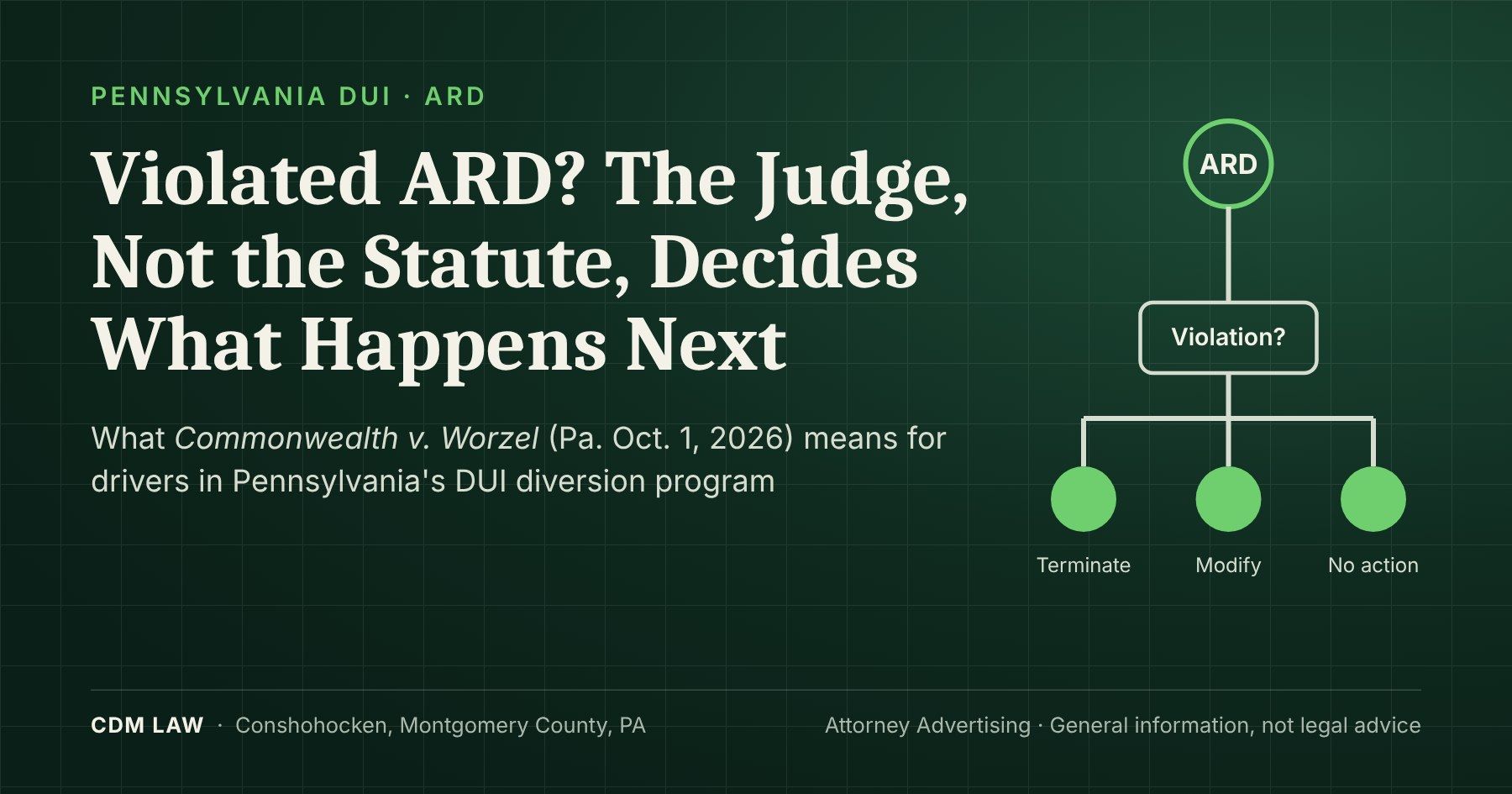
For many people charged with a first DUI in Pennsylvania, Accelerated Rehabilitative Disposition, or ARD, is the most important word in the case. ARD is a pretrial diversion program. A participant who completes it can have the DUI charge dismissed instead of facing a conviction.
But ARD comes with conditions, and people sometimes slip. What happens then? In a recent appeal, the Commonwealth argued that the DUI statute required a judge to end ARD after any violation and send the case back for prosecution. On October 1, 2026, the Supreme Court of Pennsylvania rejected that argument in Commonwealth v. Worzel, No. 36 MAP 2025.
This article explains what the Court decided, what it did not decide, and how Worzel fits with the other major ARD changes Pennsylvania has seen since 2025.
ARD in a Pennsylvania DUI Case: The Basics
ARD for DUI charges is governed by Section 3807 of the Vehicle Code, 75 Pa.C.S. § 3807, and by Pennsylvania Rules of Criminal Procedure 310 through 320. A few points are worth knowing:
- The district attorney decides whether to offer ARD. A person cannot simply demand it.
- Some cases are excluded by statute. Under Section 3807(a)(2), a DUI charge generally cannot be submitted for ARD if the person was found guilty of, or accepted ARD for, a DUI within the prior ten years (with a narrow exception for certain first-offense, ungraded general impairment cases); if an accident connected to the offense killed or seriously injured someone other than the defendant; or if a passenger under 14 was in the vehicle.
- The program has conditions. Typical conditions include supervision, costs, a safe driving program and an evaluation for treatment needs. Counties may add their own conditions. In Worzel, for example, Pike County's program barred participants from possessing or consuming alcohol.
What Happened in Worzel
According to the Supreme Court's opinion, Megan Worzel was arrested for DUI in Pike County in October 2020. It was her first DUI. She entered ARD in June 2021 and was placed on six months of supervision, subject to the county's no-alcohol condition.
In December 2021, near the end of the program, she tested positive for alcohol and admitted drinking. The Commonwealth moved to terminate her ARD. The trial court found that she had violated the condition but declined to terminate. Instead, it extended her supervision by 90 days, and she completed the program.
The Commonwealth then filed new charges anyway. The trial court dismissed them, and the Superior Court affirmed. Commonwealth v. Worzel, 328 A.3d 1194 (Pa. Super. 2024). The Commonwealth appealed to the Supreme Court.
The Question: Does "Shall" Mean Automatic Termination?
The Commonwealth relied on Section 3807(e)(2). When a DUI ARD participant violates a program condition, that provision says the court "shall direct the attorney for the Commonwealth to proceed on the charges." In the Commonwealth's view, the word "shall" left no room for judgment: any violation meant termination and prosecution.
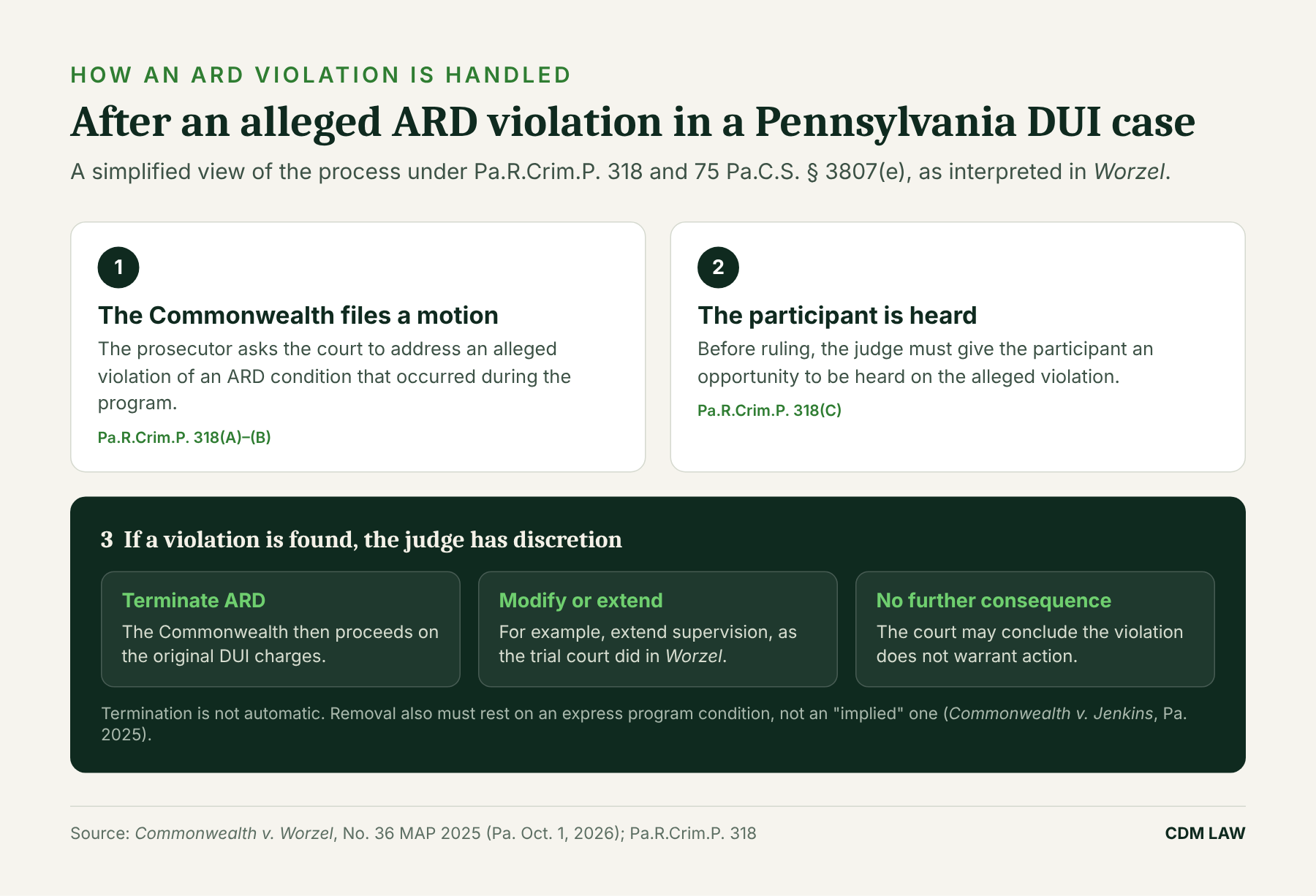
The procedural rule points the other way. Pa.R.Crim.P. 318(C) requires the judge to give the participant an opportunity to be heard, and then says the judge "may order, when appropriate, that the program be terminated."
The Holding: Judges Keep Their Discretion
In a majority opinion by Justice Wecht, the Supreme Court affirmed. The Court held that Section 3807(e)(2) does not require automatic termination, and that trial courts keep their discretion under Rule 318(C) to terminate or modify a DUI defendant's ARD participation after a violation. The Court read the statute together with the rule rather than in conflict with it.
The Court explained that, after a violation, a judge is not required to terminate the program. Depending on the circumstances, the judge may:
- terminate ARD and direct the Commonwealth to proceed on the charges;
- modify the program, for example by extending supervision, as the trial court did in Worzel; or
- decide that the violation does not warrant any further consequence.
The Court supported its reading with several tools of interpretation, including constitutional avoidance (the Pennsylvania Constitution, Article V, § 10(c), gives the Supreme Court power over rules of procedure), the Statutory Construction Act, its own precedent and the rule of lenity. Justice Brobson joined the opinion except for the rule-of-lenity section.
What Worzel Does Not Mean
Worzel is good news for ARD participants, but it is not a free pass. A few cautions:
- Termination is still possible. The decision preserves the judge's discretion; it does not guarantee leniency. A judge may still terminate ARD when the judge believes the violation warrants it.
- The hearing matters. Because the outcome now depends on the judge's judgment, what the participant can show at the Rule 318 hearing (proof of compliance, treatment progress, explanations for missed obligations) can matter a great deal.
- The condition must be real and express. In a separate 2025 decision, Commonwealth v. Jenkins, No. 36 MAP 2024 (Pa. Oct. 23, 2025), the Supreme Court held that ARD cannot be revoked based on an "implied" condition or on conduct that occurred before the person entered the program.
The Bigger Picture: ARD Has Changed a Lot Since 2025
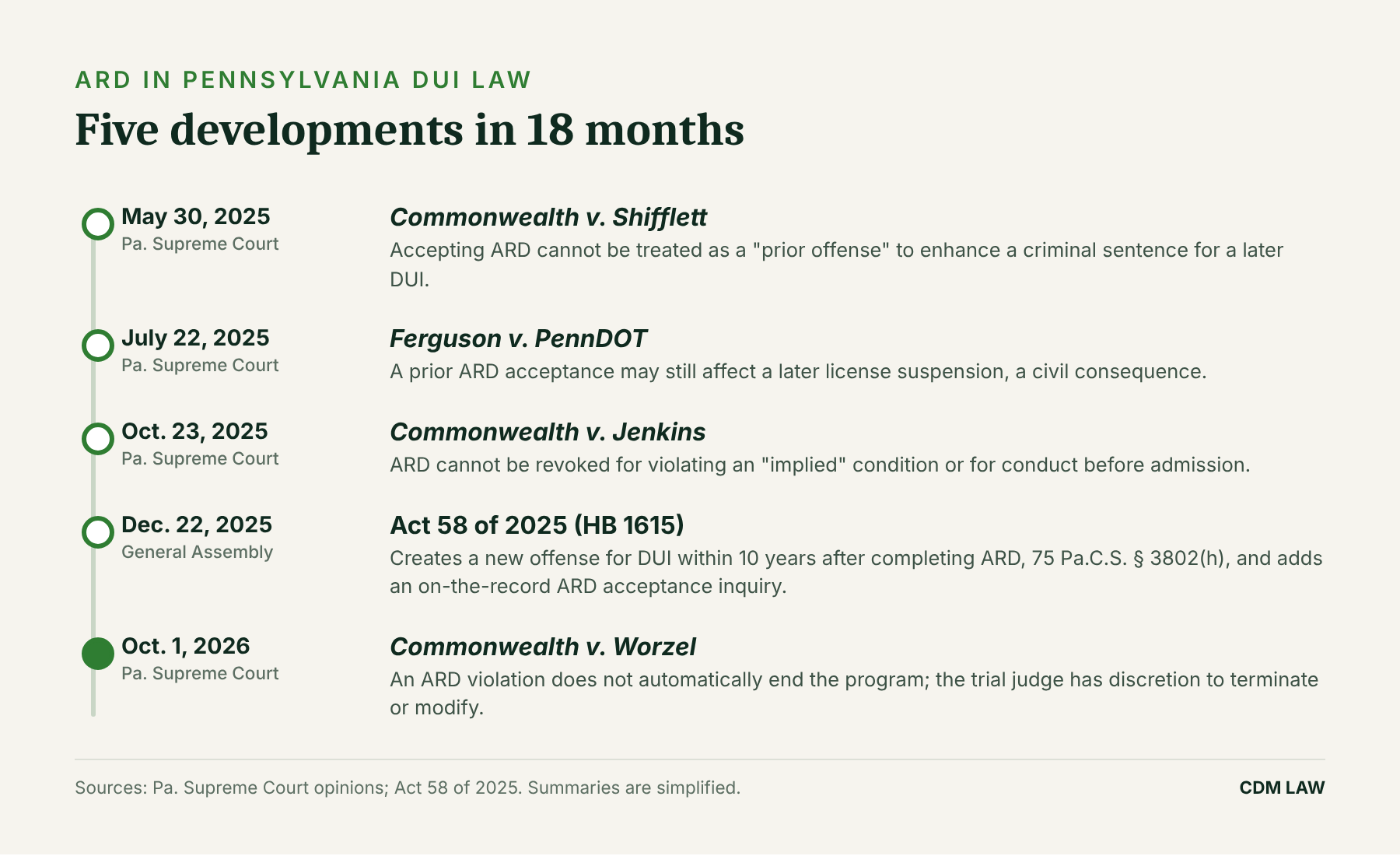
Worzel is the latest in a series of developments that affect anyone considering or completing ARD on a DUI charge.
1. ARD alone no longer enhances a criminal sentence
In Commonwealth v. Shifflett, No. 26 MAP 2024 (Pa. May 30, 2025), the Supreme Court held that Section 3806 of the Vehicle Code was unconstitutional to the extent it allowed a prior acceptance of ARD to be treated as a "prior offense" to increase the criminal sentence for a later DUI. Acceptance of ARD is not a conviction, and the Court held it cannot be used that way without the protections that come with a conviction.
2. ARD can still matter for license consequences
Two months later, in Ferguson v. Department of Transportation, Bureau of Driver Licensing, No. 73 MAP 2022 (Pa. July 22, 2025), the Court upheld a Vehicle Code provision that uses a prior ARD acceptance in determining a driver's license suspension after a later DUI conviction. Civil license consequences and criminal sentencing are treated differently.
3. The legislature created a new "DUI after diversion" offense
The General Assembly responded with Act 58 of 2025 (House Bill 1615), approved December 22, 2025, which took effect immediately. Among other changes, Act 58:
- removed ARD acceptance from the definition of "prior offense" in 75 Pa.C.S. § 3806(a);
- created a new offense at 75 Pa.C.S. § 3802(h) for driving under the influence within 10 years after completing ARD (or a substantially similar out-of-state diversion program), with penalties that generally track those for a second DUI offense;
- allows prior ARD completion to be proven through certified PennDOT or court records, and requires the clerk of courts to keep a non-public copy of the ARD completion order for 12 years for that purpose; and
- requires the court, before accepting ARD on a DUI charge, to confirm on the record that the defendant's acceptance and waiver of rights are knowing, voluntary and intelligent.
The practical result: ARD remains a valuable option for many first-time DUI cases, but it now carries a longer shadow. A person who completes ARD and is charged with another DUI within ten years may face a separate, more serious charge.
Practical Takeaways
- Get your conditions in writing and read them. After Jenkins, removal must rest on an express condition, so know exactly what yours are.
- Keep records. Save proof of payments, class completion, treatment attendance and any testing.
- Take any motion to terminate seriously. After Worzel, the judge has real choices. Preparation for the hearing may affect which one the judge makes.
- Weigh ARD with eyes open. Under Act 58, completing ARD can affect how a future DUI is charged for ten years. That is part of the decision.
Every case turns on its own facts, the specific county program and the court involved. If you are in ARD and facing an alleged violation, or are deciding whether to accept ARD, speaking with a Pennsylvania criminal defense attorney about your specific situation is the best next step.
Talk With CDM LAW
CDM LAW represents clients in DUI and criminal matters from its office at 815 Fayette Street, Suite 200, Conshohocken, Montgomery County, Pennsylvania. To discuss your situation, call (610) 994-0281 or visit cdmattorneys.com. Please do not send confidential information until an attorney-client relationship has been confirmed in writing.
Sources
- Commonwealth v. Worzel, No. 36 MAP 2025 (Pa. Oct. 1, 2026)
- Commonwealth v. Jenkins, No. 36 MAP 2024 (Pa. Oct. 23, 2025)
- Commonwealth v. Shifflett, No. 26 MAP 2024 (Pa. May 30, 2025)
- Ferguson v. PennDOT, Bureau of Driver Licensing, No. 73 MAP 2022 (Pa. July 22, 2025)
- Pennsylvania General Assembly, House Bill 1615 (Act 58 of 2025)
- 75 Pa.C.S. §§ 3802, 3806, 3807; Pa.R.Crim.P. 318
Legal Disclaimer
Attorney Advertising. This article is provided by CDM LAW for general informational purposes only. It is not legal advice, and it reflects the law as of November 17, 2026. Laws and court decisions change, and the outcome of any case depends on its specific facts. Christopher D. Mandracchia, Esq., of CDM LAW, Conshohocken, Pennsylvania, is responsible for the content of this article.
Reading this article or contacting CDM LAW through this website does not create an attorney-client relationship. You should consult a qualified attorney about your specific situation before acting on any information here. Prior results do not guarantee a similar outcome. No representation is made that any lawyer at CDM LAW is certified as a specialist in any field of law.