
Using AI in Your Ads? Pennsylvania's New AI Deceptive Advertising Act Takes Effect December 21, 2026
Act 99 of 2026 requires a clear and conspicuous label when AI-generated or AI-altered content in an ad could mislead consumers. It takes effect December 21, 2026.
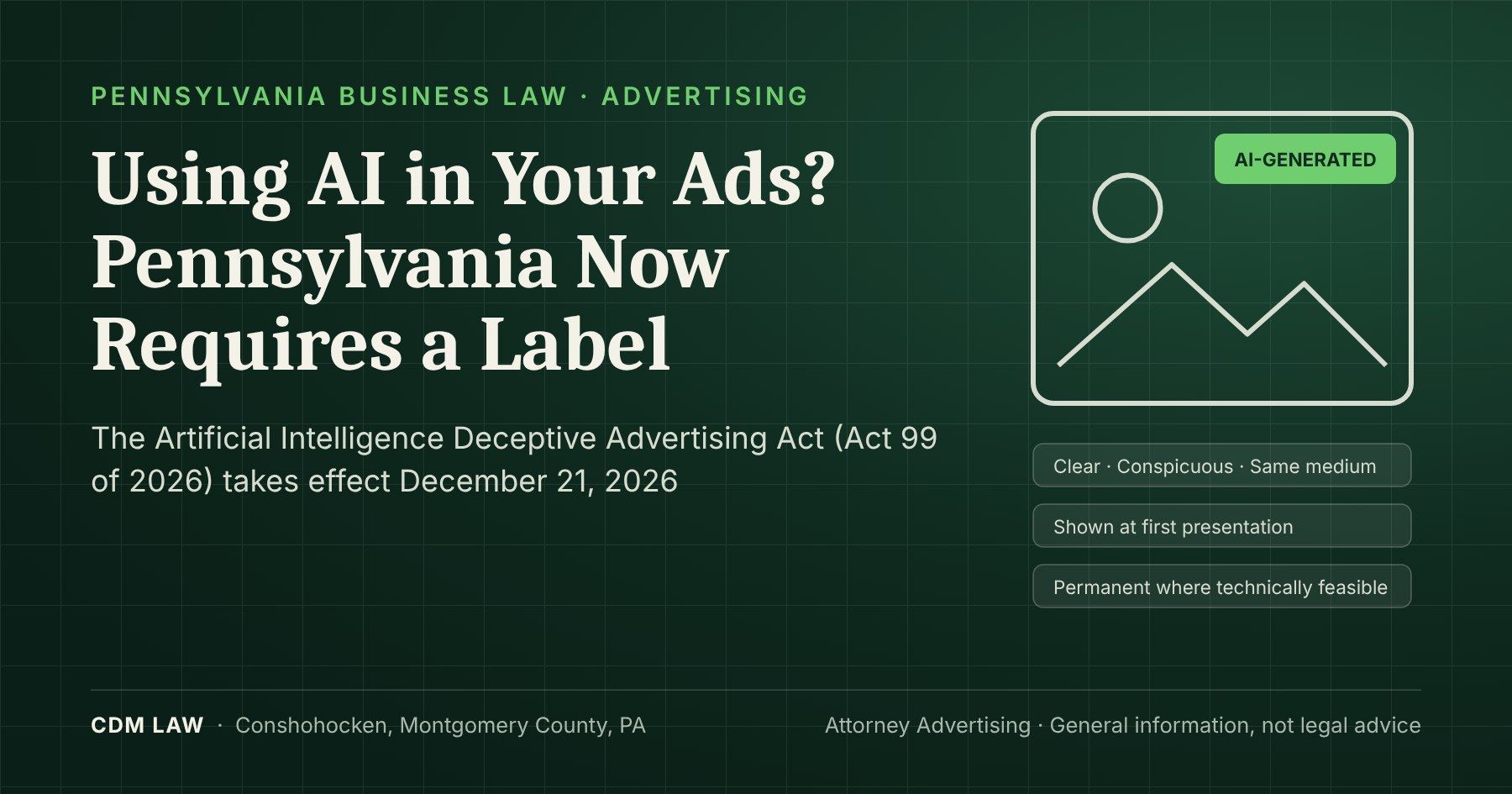
AI tools now make it easy for any business to produce polished product photos, video and voiceovers in minutes. Pennsylvania has just set a new ground rule for how that content is used in advertising.
On October 22, 2026, Governor Shapiro signed Senate Bill 806 into law as Act 99 of 2026, the Artificial Intelligence Deceptive Advertising Act. The Act takes effect 60 days after enactment, which is December 21, 2026. If your business advertises to Pennsylvania consumers and uses AI to create or edit ad content, now is the time to review your practices.
How the Law Passed
SB 806 was sponsored by Senator Nick Pisciottano. The Senate passed it 48-2 on June 10, 2026, and the House passed it 163-40 on October 7, 2026. The Governor approved it on October 22, 2026, according to the General Assembly's official bill history.
Key Definitions
- Artificial intelligence is defined broadly as a machine-based system that makes predictions, recommendations or decisions for human-defined objectives. It includes generative AI.
- Synthetic content means information such as images, video, audio clips and text that has been significantly modified or generated by AI.
- Clear and conspicuous means a disclosure that is readily noticeable and understandable to consumers in its size, placement, duration and audibility, and presented in the language the consumer uses to interact with the content.
What the Act Requires
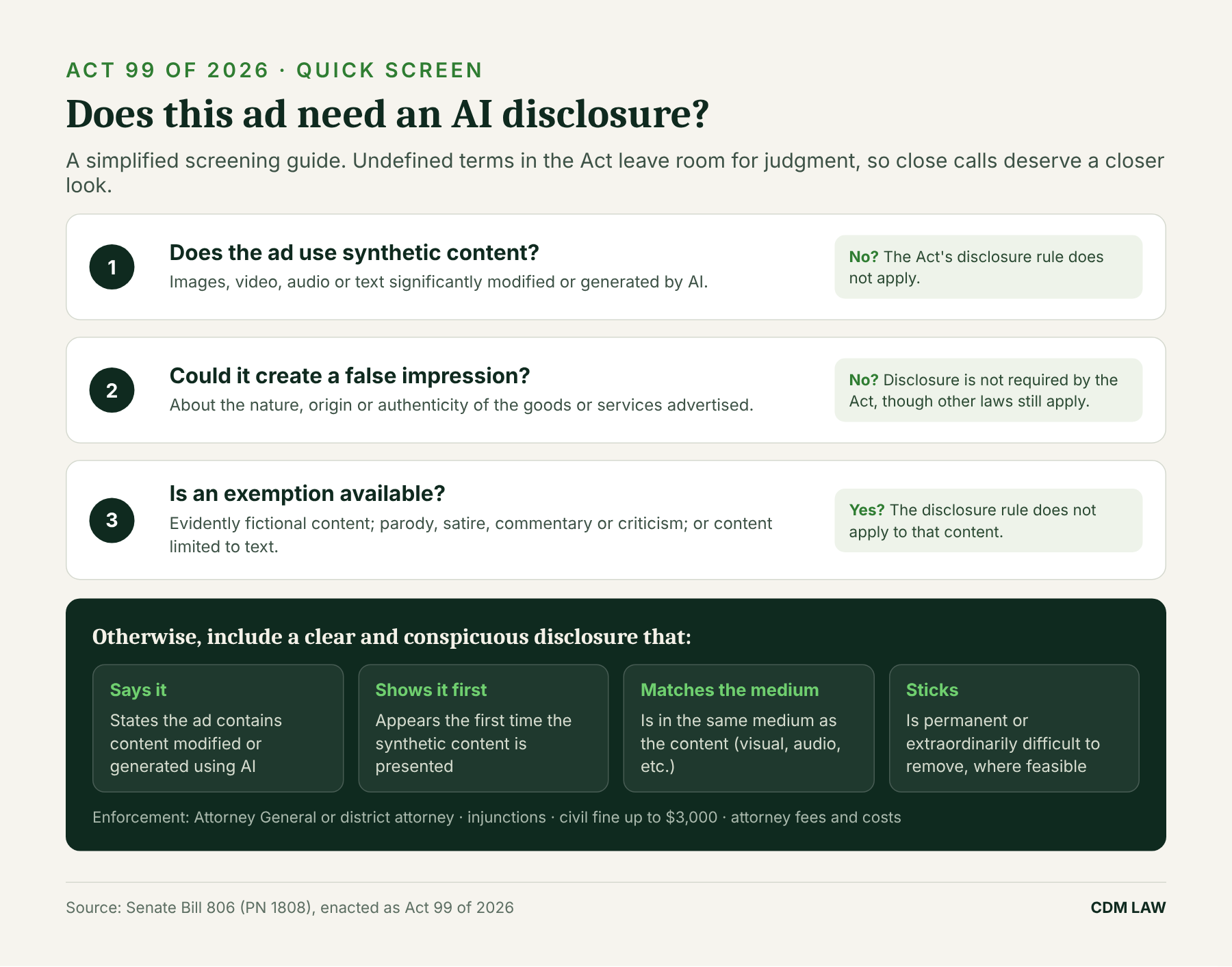
Under Section 4(a), an advertiser may not knowingly, recklessly or willfully disseminate an advertisement that uses synthetic content to create a false consumer perception about the nature, origin or authenticity of the goods or services advertised, unless the ad includes a clear and conspicuous disclosure. That disclosure must:
- state that the advertisement contains content modified or generated using artificial intelligence;
- appear the first time the synthetic content is presented to the consumer;
- be presented in the same medium as the synthetic content (a visual label for an image, an audible statement for audio); and
- where technically feasible, be permanent or extraordinarily difficult to remove.
What Is Exempt
Section 4(b) states the disclosure requirement does not apply to content that is:
- evidently fictional, based on the content or context of the depiction;
- parody, satire, commentary or criticism; or
- limited to text.
Section 4(c) adds that making the disclosure does not limit any other remedy available under the law. In other words, a label is not a safe harbor for an ad that is otherwise deceptive.
Enforcement and Penalties
The Act is enforced by the Attorney General or the appropriate district attorney, who may seek temporary or permanent injunctions and bring civil actions. A court may impose a civil fine of up to $3,000 and award actual attorney fees and court costs. The Act does not expressly create a private right of action for consumers.
Keep in mind that other laws still apply to misleading advertising, including Pennsylvania's Unfair Trade Practices and Consumer Protection Law, 73 P.S. § 201-1 et seq., and Section 5 of the Federal Trade Commission Act, 15 U.S.C. § 45. Pennsylvania also already addressed a related problem in Act 35 of 2025 (Senate Bill 649), which criminalized creating and distributing a forged digital likeness of a real person, without consent, with intent to defraud or injure.
Open Questions
As with many first-generation AI laws, some important terms are not defined, and there are no court decisions interpreting the Act yet. Businesses should be aware of these gray areas:
- "False consumer perception." The Act does not define when synthetic content creates a false impression about the nature, origin or authenticity of a product or service.
- "Significantly modified." Routine edits such as color correction or background cleanup may or may not cross this line. The Act does not say.
- Text. "Synthetic content" includes text, yet content limited to text is exempt. How that plays out for ads mixing AI-written copy with images is unclear.
- How the fine is counted. The Act sets a fine of up to $3,000 but does not say whether it applies per ad, per violation or per campaign.
Hypothetical Examples
The following examples are hypothetical and are offered only to illustrate the issues. How the Act applies to any real ad depends on its specific content and context.
- Likely higher risk: A contractor's ad shows an AI-generated "finished kitchen" photo presented as the contractor's own completed work. That could create a false perception about the origin or authenticity of the services.
- Likely higher risk: A product ad uses an AI-generated voice or video of a "customer" describing results, presented as a real person.
- Likely lower risk: An obviously cartoon mascot that no reasonable viewer would mistake for reality may fall within the "evidently fictional" exemption.
- Likely lower risk: AI-assisted ad copy alone may fall within the text-only exemption, although it remains subject to the general rules against deceptive advertising.
A Compliance Checklist for Pennsylvania Businesses
- Inventory your ads. Identify any current or planned ads that use AI-generated or AI-edited images, video or audio, including social media posts and website banners.
- Ask the key question. Could a consumer be misled about what the product or service is, where it comes from, or whether it is genuine?
- Label when in doubt. Where disclosure is required or the answer is unclear, use a clear and conspicuous label that meets all four requirements above.
- Talk with your vendors. Ask marketing agencies and freelancers to tell you when AI is used and to build disclosures into deliverables.
- Write it down. Adopt a short internal AI advertising policy and keep records of how ad content was created.
- Review before December 21, 2026. Ads that remain in circulation after the effective date should be reviewed now.
Lawyers are no exception to truthful-advertising rules. Pennsylvania attorneys are separately bound by the Rules of Professional Conduct, which prohibit false or misleading communications (Rule 7.1) and require disclosure of dramatizations and non-authentic portrayals in advertising (Rule 7.2(f)).
Talk With CDM LAW
CDM LAW advises Pennsylvania businesses on contracts and compliance matters from its office at 815 Fayette Street, Suite 200, Conshohocken, Montgomery County, Pennsylvania. To discuss how Act 99 may affect your business, call (610) 994-0281 or visit cdmattorneys.com. Please do not send confidential information until an attorney-client relationship has been confirmed in writing.
Sources
- Pennsylvania General Assembly, Senate Bill 806 (Act 99 of 2026), bill history
- Senate Bill 806, Printer's No. 1808 (final text)
- Covington & Burling, Inside Global Tech, "Pennsylvania Enacts Artificial Intelligence Deceptive Advertising Act" (Nov. 9, 2026)
- Pennsylvania Senate Republicans, "Pennycuick Bill Targeting Rise of Deepfake Scams Signed into Law" (Act 35 of 2025)
- Pa. Rule of Professional Conduct 7.2, 204 Pa. Code r. 7.2
Legal Disclaimer
Attorney Advertising. This article is provided by CDM LAW for general informational purposes only. It is not legal advice, and it reflects the law as of November 17, 2026. The Act is new, has not yet been interpreted by any court, and may be clarified by future guidance or amendment. Christopher D. Mandracchia, Esq., of CDM LAW, Conshohocken, Pennsylvania, is responsible for the content of this article.
Reading this article or contacting CDM LAW through this website does not create an attorney-client relationship. You should consult a qualified attorney about your specific situation before acting on any information here. Prior results do not guarantee a similar outcome. No representation is made that any lawyer at CDM LAW is certified as a specialist in any field of law. The graphics in this article are original illustrations created for informational purposes.