Pulled Over in Pennsylvania? Your Rights on Field Sobriety Tests, Breath and Blood Tests, DRE Evaluations and Refusal (2026)
What Pennsylvania law requires at a traffic stop, what you can decline, how police score field sobriety tests, and what refusing a breath or blood test really costs.
Red and blue lights in the mirror. What happens next can decide whether you are charged with DUI. Here is a plain-English guide to your rights at a Pennsylvania traffic stop, how field sobriety tests are given and scored, how breath, blood and drug recognition (DRE) evaluations work, and what refusing really costs.
Already been stopped or charged? Every case turns on its own facts. Call CDM LAW at (610) 994-0281. We take calls after business hours, and you can also send us a message.
This article is general information, not legal advice, and reading it does not make us your lawyers.
How a Pennsylvania DUI investigation unfolds
Police DUI training follows a playbook. The National Highway Traffic Safety Administration’s (NHTSA) DWI Detection and Standardized Field Sobriety Testing curriculum divides a DUI investigation into three phases:
- Vehicle in motion. The officer watches your driving, decides whether to stop you and watches how you stop.
- Personal contact. The officer talks with you face-to-face, looks and listens for signs of impairment and decides whether to ask you to step out.
- Pre-arrest screening. The officer gives structured field tests, decides whether there is probable cause to arrest and may use a preliminary breath test (PBT).
In Pennsylvania, officers are trained on this model. The Pennsylvania State Police (PSP) runs the state’s Drug Evaluation and Classification (DRE) program, which it describes as developed by NHTSA and approved by the International Association of Chiefs of Police (IACP), and it requires DRE candidates to be certified NHTSA SFST practitioners. Pennsylvania’s Institute for Law Enforcement Education (Department of Education) also offers sworn officers a three-day SFST practitioner course covering DUI detection, horizontal and vertical gaze nystagmus, walk-and-turn, one-leg stand and report writing. PSP’s internal field regulations are not generally published, so this guide relies on the NHTSA, IACP and PSP materials that are publicly available.
Knowing the playbook matters. Every question, request and “test” at the roadside is a step in building probable cause.
Your rights when you are pulled over in Pennsylvania
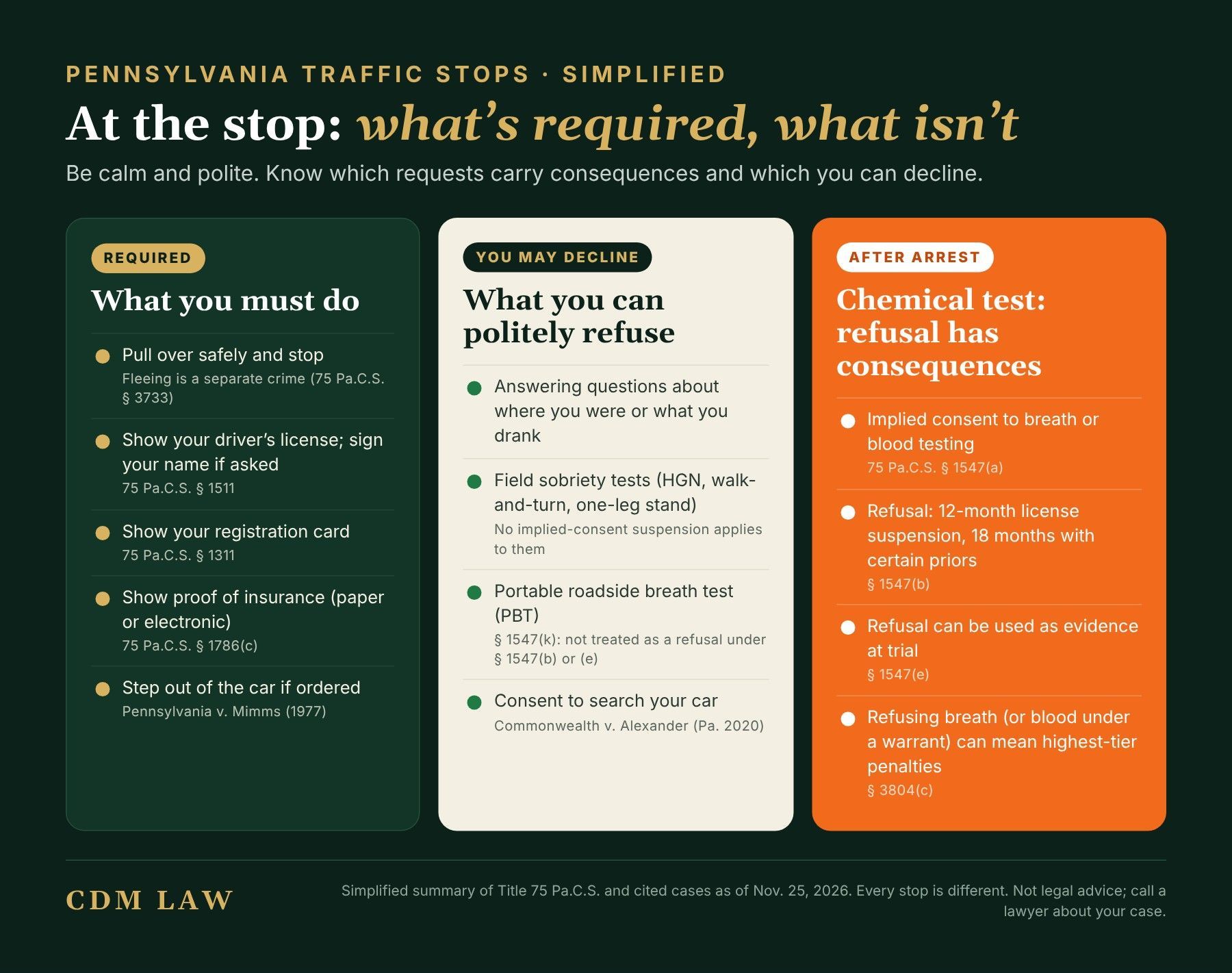
What you must do
- Stop safely. Pull over when signaled. Fleeing or attempting to elude a police officer is a separate offense under 75 Pa.C.S. § 3733.
- Show your license. Under 75 Pa.C.S. § 1511, a driver must carry a license and show it when a police officer asks, and must write his or her name in front of the officer if asked to confirm identity.
- Show your registration card on demand (75 Pa.C.S. § 1311).
- Show proof of insurance. Section 1786(c) says vehicle owners consent to produce proof of financial responsibility to police on request, and a paper or electronic insurance card satisfies it.
- Step out if ordered. In Pennsylvania v. Mimms (1977), the U.S. Supreme Court held an officer may order a driver out of a lawfully stopped car.
What you can politely decline
- Questions. You may decline to answer questions about where you were coming from, whether you were drinking or how much. Police often do not read Miranda warnings at the roadside; in Berkemer v. McCarty (1984), the U.S. Supreme Court held that ordinary roadside questioning during a routine traffic stop generally is not “custodial.” That makes your own choice to stay quiet more important, not less.
- Field sobriety tests. See below. They are voluntary.
- The roadside breath test (PBT). See below.
- A search of your car. In Commonwealth v. Alexander (Pa. Dec. 22, 2020), the Pennsylvania Supreme Court held that the Pennsylvania Constitution requires both probable cause and exigent circumstances for a warrantless car search. Consent is an exception, so police may ask. You can say, “I do not consent to any searches.” Do not physically resist.
You do not have to perform field sobriety tests
Pennsylvania’s implied consent law, 75 Pa.C.S. § 1547(a), applies to chemical tests of breath or blood. No provision of the Vehicle Code requires a driver to perform the horizontal gaze nystagmus, walk-and-turn or one-leg stand tests, and declining them does not trigger the implied-consent license suspension.
Two cautions. First, declining field tests does not stop an arrest: an officer can still arrest based on driving, odor, speech, admissions and other observations. Second, whether a prosecutor may mention that you declined depends on the facts and is something to discuss with your lawyer. What you can control is how much evidence you give. Roadside conditions, footwear, injuries, age and nerves can all affect performance, and NHTSA’s own materials acknowledge some of these limits.
The portable breath test (PBT) is different from the station test
Section 1547(k) lets an officer with reasonable suspicion ask a driver to take a preliminary breath test on a Department of Health-approved device before arrest. Its “sole purpose” is to help the officer decide whether to arrest, and the statute says refusing it “shall not be considered” for the refusal-suspension and refusal-evidence provisions in § 1547(b) and (e). It is not the evidentiary breath test given after arrest.
How standardized field sobriety tests are performed and scored
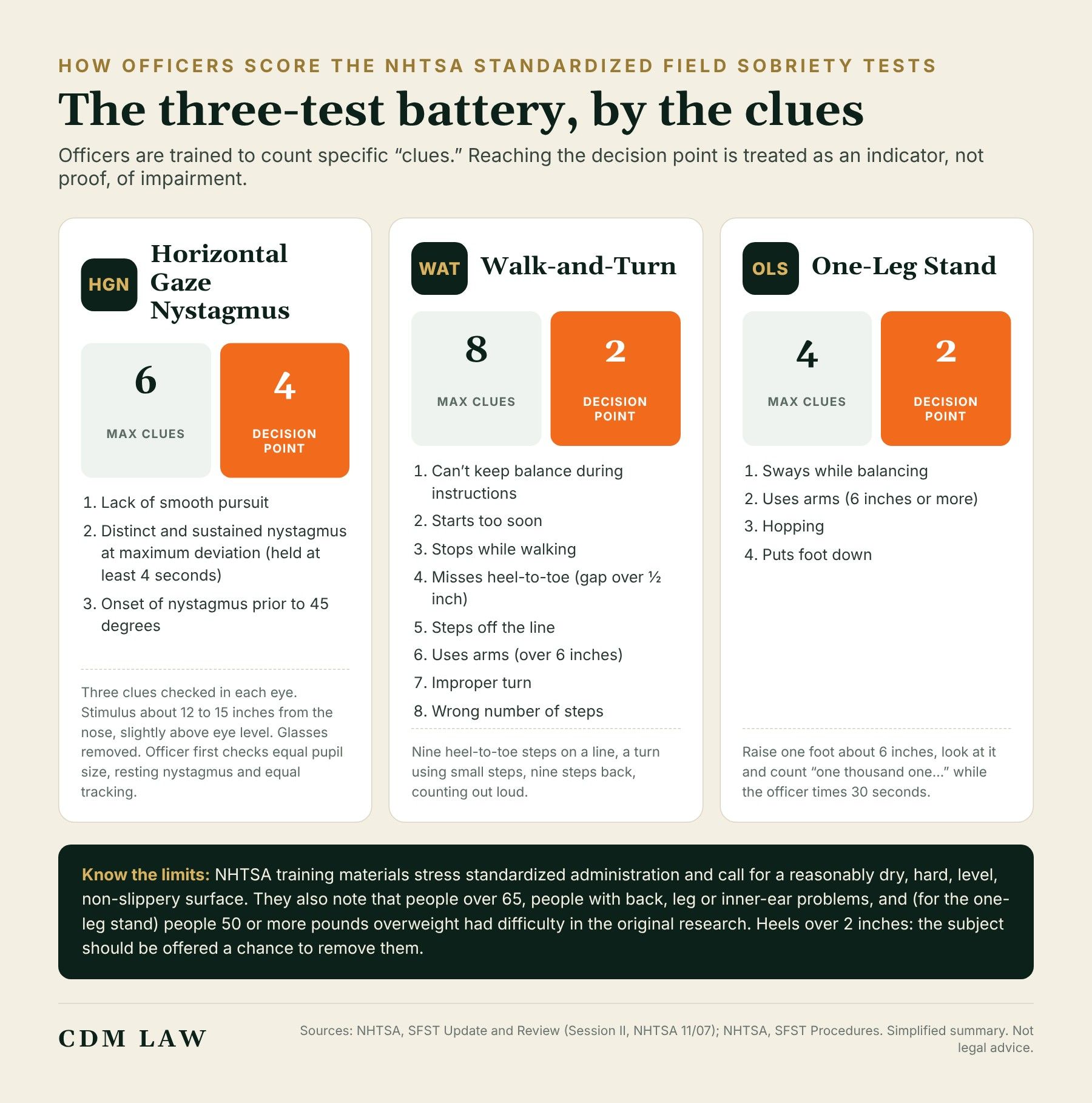
Field sobriety tests are not pass/fail. Officers trained in the NHTSA curriculum count specific “clues,” and reaching a set number (the “decision point”) is treated as an indicator of impairment. The details below come from NHTSA training materials.
1. Horizontal Gaze Nystagmus (HGN)
How it’s given: The officer has you remove glasses, keep your head still and follow a stimulus (often a pen or penlight) with your eyes only. NHTSA materials say the stimulus should be about 12 to 15 inches from your nose and slightly above eye level. Before scoring, the officer is trained to check for equal pupil size, resting nystagmus and equal tracking, because differences can signal a medical issue or injury.
The clues (three per eye, six total):
- Lack of smooth pursuit. Each pass should take about two seconds out and two seconds back.
- Distinct and sustained nystagmus at maximum deviation. The eye is held at the far side for at least four seconds.
- Onset of nystagmus prior to 45 degrees. The stimulus moves slowly, taking about four seconds to reach the edge of the shoulder.
Decision point: four or more clues. Officers may also check for vertical gaze nystagmus(jerking of the eyes when looking up) by raising the stimulus and holding it about four seconds.
Why it matters for your defense: HGN depends on precise technique. The same NHTSA materials stress stimulus distance and speed, a stimulus that contrasts with the background, the officer’s position and medical screening, and note that holding the eyes at maximum deviation for more than about 30 seconds can cause fatigue nystagmus. Video often shows whether the steps were followed.
2. Walk-and-Turn (WAT)
Instruction stage: you stand heel-to-toe on a line with arms at your sides and are told not to start until instructed. Walking stage: nine heel-to-toe steps, a turn keeping the front foot on the line and taking a series of small steps, then nine steps back, counting out loud, watching your feet and keeping your arms down.
The eight clues: can’t keep balance during instructions; starts too soon; stops while walking; misses heel-to-toe (a gap of more than one-half inch); steps off the line; uses arms (more than six inches from the side); improper turn; wrong number of steps. Decision point: two or more clues, or inability to complete the test.
3. One-Leg Stand (OLS)
You stand with feet together and arms at your sides, then raise either foot about six inches with your foot parallel to the ground, look at the raised foot and count out loud (“one thousand one, one thousand two…”) until told to stop. The officer times 30 seconds.
The four clues: sways while balancing; uses arms (six inches or more); hopping; puts foot down. Decision point: two or more clues, or inability to complete the test.
How accurate are they?
NHTSA training materials report that in the original research, at a 0.10% BAC standard, HGN alone was 77% accurate, walk-and-turn 68% and one-leg stand 65%, and HGN and walk-and-turn combined were 80% accurate. A 1998 NHTSA-funded field study in San Diego (Stuster & Burns) reported that the three-test battery was accurate in 91% of cases at 0.08%. Read the other way, the original research numbers mean a meaningful share of decisions were wrong.
Breath and blood testing after a DUI arrest
Implied consent and the DL-26 warnings
Under § 1547(a), anyone who drives in Pennsylvania is “deemed to have given consent” to chemical testing of breath or blood when an officer has reasonable grounds to believe the person was driving under the influence. After an arrest, officers typically read PennDOT’s implied-consent warnings: form DL-26A for breath and DL-26B for blood. Under the Pennsylvania Supreme Court’s decision in Commonwealth, Department of Transportation v. O’Connell (1989) and the cases that followed, you do not have a right to speak with a lawyer before deciding whether to submit to chemical testing. Listen carefully to the warnings, because how you respond matters.
Evidentiary breath tests: the rules police must follow
Pennsylvania’s breath-testing regulation, 67 Pa. Code § 77.24, requires, among other things:
- At least 20 consecutive minutes of observation before the first test, during which the person may not drink, eat, smoke, vomit or regurgitate.
- A certified breath test operator.
- Two consecutive breath tests, followed by a simulator (calibration-check) test; the lower result is used.
- Results are disregarded if the two breath tests differ by 0.02 or more (or 0.020 on three-decimal devices), or if the simulator test falls outside the allowed range.
Blood tests
Pennsylvania’s DUI tiers are based on BAC measured within two hours after driving (75 Pa.C.S. § 3802). In Birchfield v. North Dakota (2016), the U.S. Supreme Court held that states may not criminally punish a driver for refusing a warrantless blood test. Pennsylvania’s statute now applies the enhanced refusal penalties to a refusal of breath testing, or of blood testing under a valid search warrant (§ 3804(c)). But in Commonwealth v. Bell (Pa. July 17, 2019), the Pennsylvania Supreme Court held that a refusal of a warrantless blood test may still be admitted as evidence at trial under § 1547(e). Police can also seek a warrant for a blood draw.
Drug Recognition Expert (DRE) evaluations
When an officer suspects drugs, including marijuana or prescription medication, a certified Drug Recognition Expert may be called. PSP says its DEC program began in 2004, and that the IACP and PSP are the regulating and certifying organizations for the program in Pennsylvania. Certification requires, among other things, at least 12 supervised evaluations and a 75% toxicology confirmation rate.
The IACP describes a 12-step evaluation:
- Breath alcohol test to see whether alcohol explains the observed impairment.
- Interview of the arresting officer.
- Preliminary examination and first pulse, including health questions and an initial eye check.
- Eye examinations: HGN, vertical gaze nystagmus and lack of convergence.
- Divided-attention tests: Modified Romberg Balance, walk-and-turn, one-leg stand and finger-to-nose.
- Vital signs and second pulse: blood pressure, temperature and pulse.
- Dark room examinations of pupil size under three lighting conditions.
- Muscle tone check.
- Check for injection sites and third pulse.
- Subject’s statements and other observations, usually after Miranda warnings.
- Analysis and opinion of the evaluator on impairment and the drug categories involved.
- Toxicological examination(a chemical test).
A DRE’s conclusion is an opinion. Whether each step was done, documented and supported by the toxicology is often contested. You can decline to answer questions during the evaluation. Cannabis-related cases have their own issues; see our page on marijuana-related DUI in Pennsylvania.
Refusal: what it really costs
- License suspension (civil, from PennDOT): 12 months for a refusal, or 18 months if you previously had a refusal suspension or a prior DUI sentence (§ 1547(b)). A restoration fee of up to $2,000 can also apply. This is separate from the criminal case.
- Evidence at trial: a refusal of chemical testing may be introduced as evidence (§ 1547(e)).
- Tougher criminal penalties: if you refused breath testing (or blood testing under a valid warrant) and are convicted of general-impairment DUI under § 3802(a)(1), you face the highest-tier penalties in § 3804(c).
- The roadside PBT is the exception: refusing it is not treated as a refusal under § 1547(b) or (e) (see § 1547(k)).
Pennsylvania DUI penalties: first, second and third offense
Pennsylvania’s penalties depend on your BAC tier and on how many “prior offenses” you have, which generally means DUIs within the previous 10 years (§ 3806(b)).
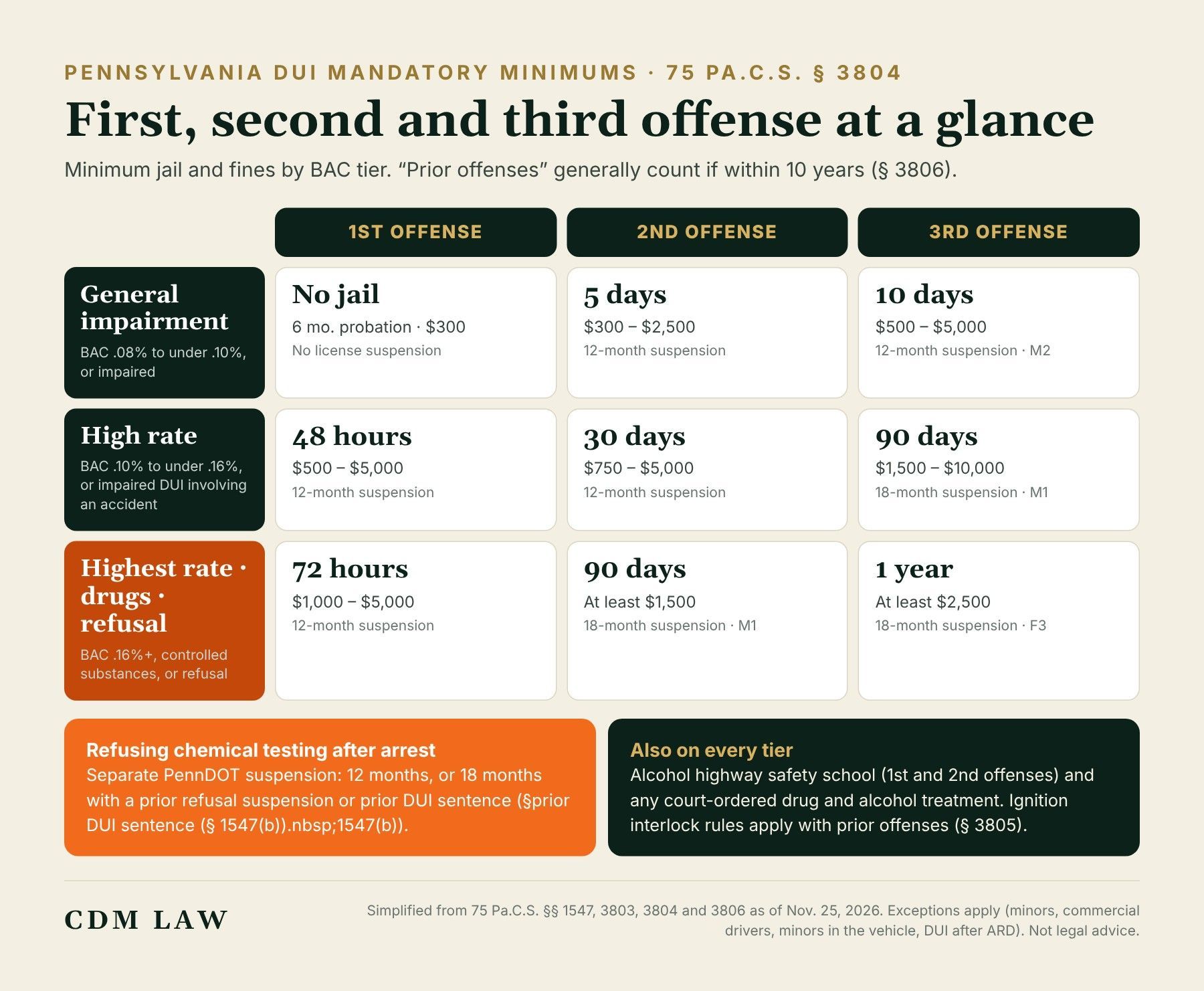
| Tier | First offense | Second offense | Third offense |
|---|---|---|---|
| General impairment
BAC .08% to under .10%, or impaired |
6 months’ probation; $300 fine; no license suspension | 5 days’ jail; $300–$2,500; 12-month suspension | 10 days’ jail; $500–$5,000; 12-month suspension; 2nd-degree misdemeanor |
| High rate
BAC .10% to under .16%, or impaired DUI involving an accident |
48 consecutive hours; $500–$5,000; 12-month suspension | 30 days; $750–$5,000; 12-month suspension | 90 days; $1,500–$10,000; 18-month suspension; 1st-degree misdemeanor |
| Highest rate, drugs or refusal
BAC .16%+, controlled substances, or refusal |
72 consecutive hours; $1,000–$5,000; 12-month suspension | 90 days; at least $1,500; 18-month suspension; 1st-degree misdemeanor | 1 year; at least $2,500; 18-month suspension; 3rd-degree felony |
- First and second offenses also require alcohol highway safety school, and every tier requires compliance with any court-ordered drug and alcohol treatment (§ 3804).
- Ignition interlock requirements generally apply to people with a prior offense (§ 3805).
- Having a minor in the vehicle raises the grading and adds penalties (§§ 3803(b)(5), 3804(c.1)).
- A DUI within 10 years after completing ARD can be charged as “DUI following diversion” under § 3802(h) and carries second-offense minimums. See our posts on Thanksgiving DUI laws and ARD and the 2026 Worzel decision.
- Fourth and later offenses are graded as felonies, and some tiers carry longer mandatory minimums.
Common Pennsylvania traffic laws that lead to stops
Most DUI cases start with an ordinary traffic stop. A few Vehicle Code rules that come up often:
- Speeding (§ 3362). 35 mph in an urban district unless posted otherwise, and other limits as posted.
- Turn signals (§ 3334). Signal continuously for at least the last 100 feet before turning at under 35 mph, and the last 300 feet above 35 mph, including lane changes.
- Lane use (§ 3309) and following too closely (§ 3310): drive within a single lane as nearly as practicable and leave a reasonable and prudent distance.
- Handheld phones (§ 3316.1, “Paul Miller’s Law”). Using an interactive mobile device while driving is a summary offense with a $50 fine, with an emergency exception.
- Move over (§ 3327). When passing an emergency response area or a disabled vehicle, move to a non-adjacent lane if possible; if not, slow to at least 20 mph below the posted limit.
- Paperwork (§§ 1511, 1311, 1786). License, registration and proof of insurance.
The legality of the stop itself is often the first thing a defense lawyer examines. If the stop was unlawful, the evidence that followed may be challenged.
If you are pulled over: a quick checklist
- Pull over safely, turn off the engine, turn on the interior light and keep your hands on the wheel.
- Provide your license, registration and proof of insurance.
- Be polite. You may say: “I’d prefer not to answer questions.”
- You may decline field sobriety tests and the roadside PBT: “I respectfully decline any field tests.”
- Do not consent to a search. Do not resist.
- If arrested, listen carefully to the chemical-test warnings. Refusing a post-arrest breath or blood test has serious consequences, so understand them before you decide.
- Write down everything as soon as you can, then call a DUI lawyer. PennDOT notices carry short appeal deadlines.
Arrested for DUI in Pennsylvania? Call CDM LAW, day or night.
DUI cases are fact-specific. The stop, the field tests, the breath or blood procedures and the paperwork all matter, and deadlines start right away. CDM LAW defends drivers in Montgomery County, Philadelphia and throughout Southeastern Pennsylvania.
We take calls after business hours. Call (610) 994-0281 or reach us through our contact page. Learn more at cdmattorneys.com and on our DUI and traffic defense and criminal defense pages.
About the author: Christopher D. Mandracchia, Esq.
Christopher D. Mandracchia is a Pennsylvania trial attorney and the founder of CDM LAW, LLC in Conshohocken. He began his career as an Assistant District Attorney in Berks County, serving from 2010 through 2015 and prosecuting multiple jury trials, so he knows how DUI and criminal cases are built from the prosecution’s side. He continued his civil and criminal trial practice at Mandracchia Law before founding CDM LAW in 2019. With more than 15 years of legal experience, Chris defends people charged with DUI and other criminal offenses and personally handles his clients’ cases in the courtroom and at the negotiating table.
He earned his undergraduate degree from Duke University and his law degree from St. Thomas University College of Law, and is admitted in Pennsylvania and the U.S. District Courts for the Eastern and Middle Districts of Pennsylvania. Read Chris’s full bio.
Pennsylvania DUI stop FAQs
Do I have to do field sobriety tests in Pennsylvania?
No. Pennsylvania’s implied consent law, 75 Pa.C.S. § 1547, covers chemical tests of breath or blood, not field sobriety tests. Declining field tests does not trigger an implied-consent license suspension, although an officer may still arrest based on other evidence.
Can I refuse the roadside breath test (PBT) in Pennsylvania?
Under 75 Pa.C.S. § 1547(k), the preliminary breath test is used only to help the officer decide whether to arrest, and refusing it is not treated as a refusal for the license suspension or refusal-evidence provisions of § 1547(b) and (e). The evidentiary breath or blood test after arrest is different.
What happens if I refuse a breath or blood test after a DUI arrest?
PennDOT suspends your license for 12 months, or 18 months with a prior refusal suspension or prior DUI sentence. The refusal can be used as evidence, and refusing breath testing (or blood testing under a warrant) can lead to highest-tier penalties if you are convicted of general-impairment DUI.
How are field sobriety tests scored?
Under NHTSA training, officers count clues: six possible on horizontal gaze nystagmus (decision point four), eight on walk-and-turn (decision point two) and four on one-leg stand (decision point two).
What is a DRE evaluation?
A Drug Recognition Expert evaluation is a 12-step process described by the IACP, used when drug impairment is suspected. It includes eye exams, divided-attention tests, vital signs, a dark room pupil exam, muscle tone, a check for injection sites, the evaluator’s opinion and a toxicology test.
What are the penalties for a first DUI in Pennsylvania?
They range from six months’ probation and a $300 fine with no license suspension (general impairment) to at least 72 hours in jail, a $1,000 to $5,000 fine and a 12-month suspension (highest rate, drugs or refusal). Many first offenders may be eligible for ARD.
We are not your attorney. Reading this post, calling our office or sending us a message does not create an attorney-client relationship. CDM LAW represents you only after we have agreed in writing to do so. Please do not send confidential information until then.
Not legal advice. This article provides general information about Pennsylvania law as of November 25, 2026. It is not legal advice and should not be relied on as such. Statutes and cases are summarized in simplified form and include exceptions not described here. Laws, regulations and court decisions change.
Every case is fact-specific. The outcome of any DUI or traffic matter depends on its own facts. Call and consult with an attorney about your situation before making decisions. Past results do not guarantee a similar outcome.
Attorney advertising. Published by CDM LAW, LLC, 815 Fayette Street, Suite 200, Conshohocken, PA 19428. Christopher D. Mandracchia, Esq. is responsible for its content. Police training descriptions are drawn from publicly available NHTSA, IACP and Pennsylvania State Police materials; agencies’ practices may vary. Images are original illustrations created for CDM LAW. If you have been drinking, do not drive. In an emergency, call 911.
Sources
- 75 Pa.C.S. § 1547 (chemical testing; refusal; preliminary breath test): Pennsylvania General Assembly, Title 75, Chapter 15(also § 1511)
- 75 Pa.C.S. §§ 3802, 3803, 3804, 3805, 3806: Pennsylvania General Assembly, Title 75, Chapter 38
- 75 Pa.C.S. §§ 3309, 3310, 3316.1, 3327, 3334, 3362: Pennsylvania General Assembly, Title 75, Chapter 33
- 75 Pa.C.S. § 1311: Title 75, Chapter 13; 75 Pa.C.S. § 1786: Title 75, Chapter 17
- 67 Pa. Code § 77.24 (breath test procedures): Pennsylvania Code & Bulletin
- PennDOT implied-consent warning forms DL-26A (breath) and DL-26B (blood)
- NHTSA, DWI Detection and Standardized Field Sobriety Testing Participant Manual (HS172A R9/09): nhtsa.gov
- NHTSA, Standardized Field Sobriety Tests: Update and Review (Session II, NHTSA 11/07): maine.gov
- NHTSA, Standardized Field Sobriety Testing Procedures : nj.gov
- Stuster & Burns, Validation of the Standardized Field Sobriety Test Battery at BACs Below 0.10 Percent , DOT HS 808 839 (Aug. 1998): ojp.gov
- IACP, “12 Step Process”: theiacp.org
- Pennsylvania State Police, “Apply to the PSP Drug Recognition Expert Training Program”: pa.gov
- Pennsylvania State Police, “Drug Evaluation and Classification Program”: psp.pa.gov
- Pa. Dept. of Education, Institute for Law Enforcement Education, “Alcohol Related Programs”: pa.gov
- Commonwealth v. Alexander , No. 30 EAP 2019 (Pa. Dec. 22, 2020): Justia
- Commonwealth v. Bell , No. 11 MAP 2018 (Pa. July 17, 2019): Justia
- Commonwealth, Dep’t of Transp. v. O’Connell , 521 Pa. 242, 555 A.2d 873 (1989): Leagle
- Birchfield v. North Dakota , No. 14-1468 (U.S. 2016): Justia
- Berkemer v. McCarty , 468 U.S. 420 (1984): govinfo.gov
- Pennsylvania v. Mimms , 434 U.S. 106 (1977): Justia