Gobble, Don't Wobble: Thanksgiving DUI Laws in Pennsylvania (2026)
Blackout Wednesday, Operation Safe Holiday and Pennsylvania's new "DUI following diversion" law: what every driver should know before passing the gravy.
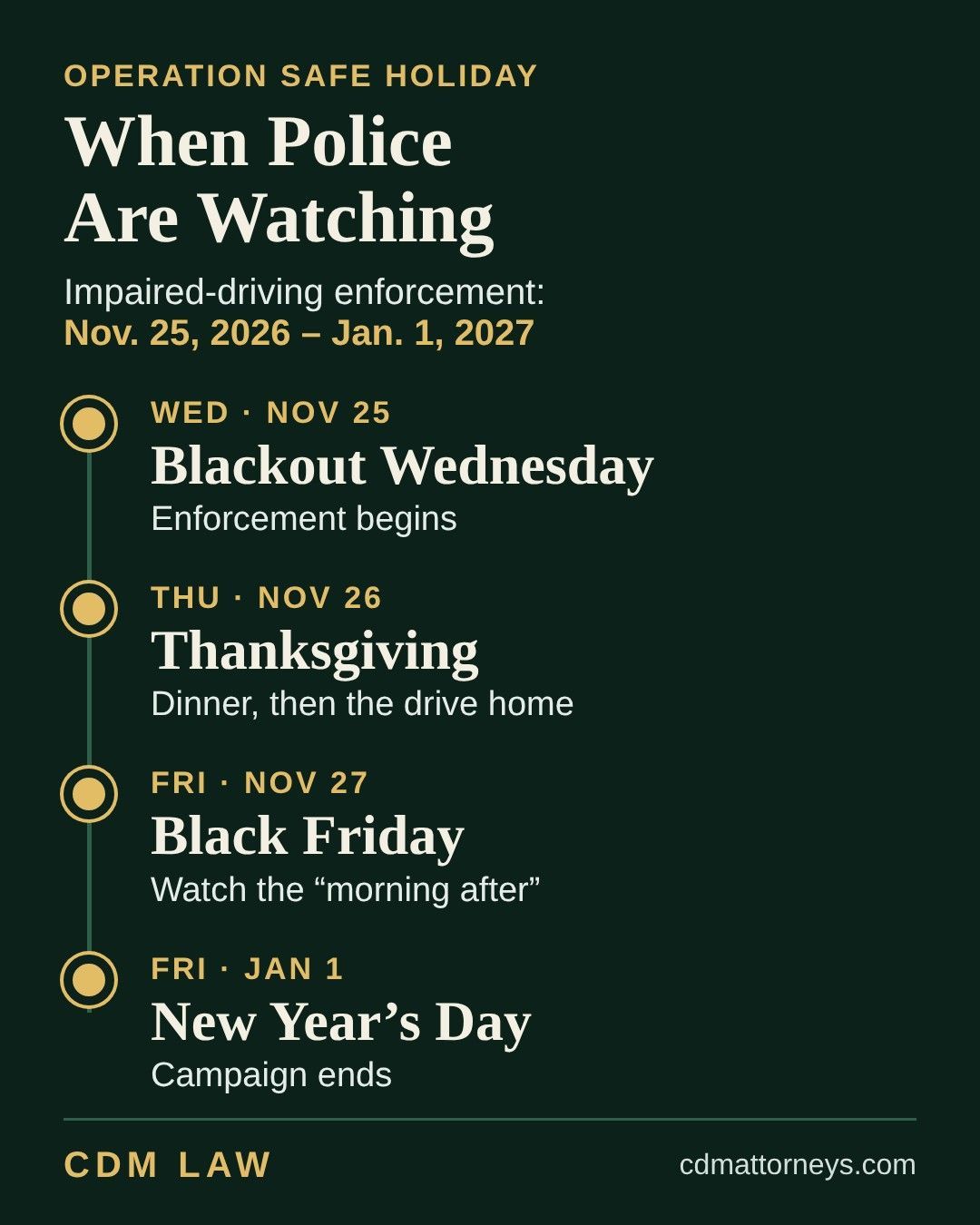
Thanksgiving week in Pennsylvania, by the numbers
Every November, a turkey somewhere gets a pardon. Pennsylvania police, unfortunately, are not in the pardoning business, and Thanksgiving week is one of their busiest stretches of the year for DUI enforcement.
The holiday is a perfect recipe for trouble. Wednesday night brings hometown reunions at the local bar (the night many people call “Blackout Wednesday”). Thursday brings wine with dinner, beer with football and a long drive home. Friday brings a 5 a.m. Black Friday alarm on not much sleep. Mix all of that with stepped-up patrols and you get a holiday nobody wants: one that ends with a mugshot instead of a slice of pumpkin pie.
We’re going to keep this light, because it’s Thanksgiving. Impaired driving is not a joke, though, and the consequences under Pennsylvania law are very real. Here is what every Pennsylvania driver should know before passing the gravy.
Why Thanksgiving week is peak DUI season in Pennsylvania
Over the five-day Thanksgiving holiday period in 2025 (November 26 to 30), the Pennsylvania State Police reported 1,183 crashes, six deaths and 458 DUI arrests. Impaired driving was a factor in 61 of those crashes. Those numbers count only incidents the State Police investigated. Local and municipal police departments make their own arrests on top of that.
This year, the State Police and PennDOT are running Operation Safe Holiday together with West Virginia and Ohio. Its impaired-driving phase starts on Wednesday, November 25 and runs through January 1, with sobriety checkpoints, roving patrols and regular traffic patrols. PennDOT Secretary Mike Carroll put it plainly: crashes caused by alcohol or drugs are “completely preventable.”
Thanksgiving DUI myths, carved up
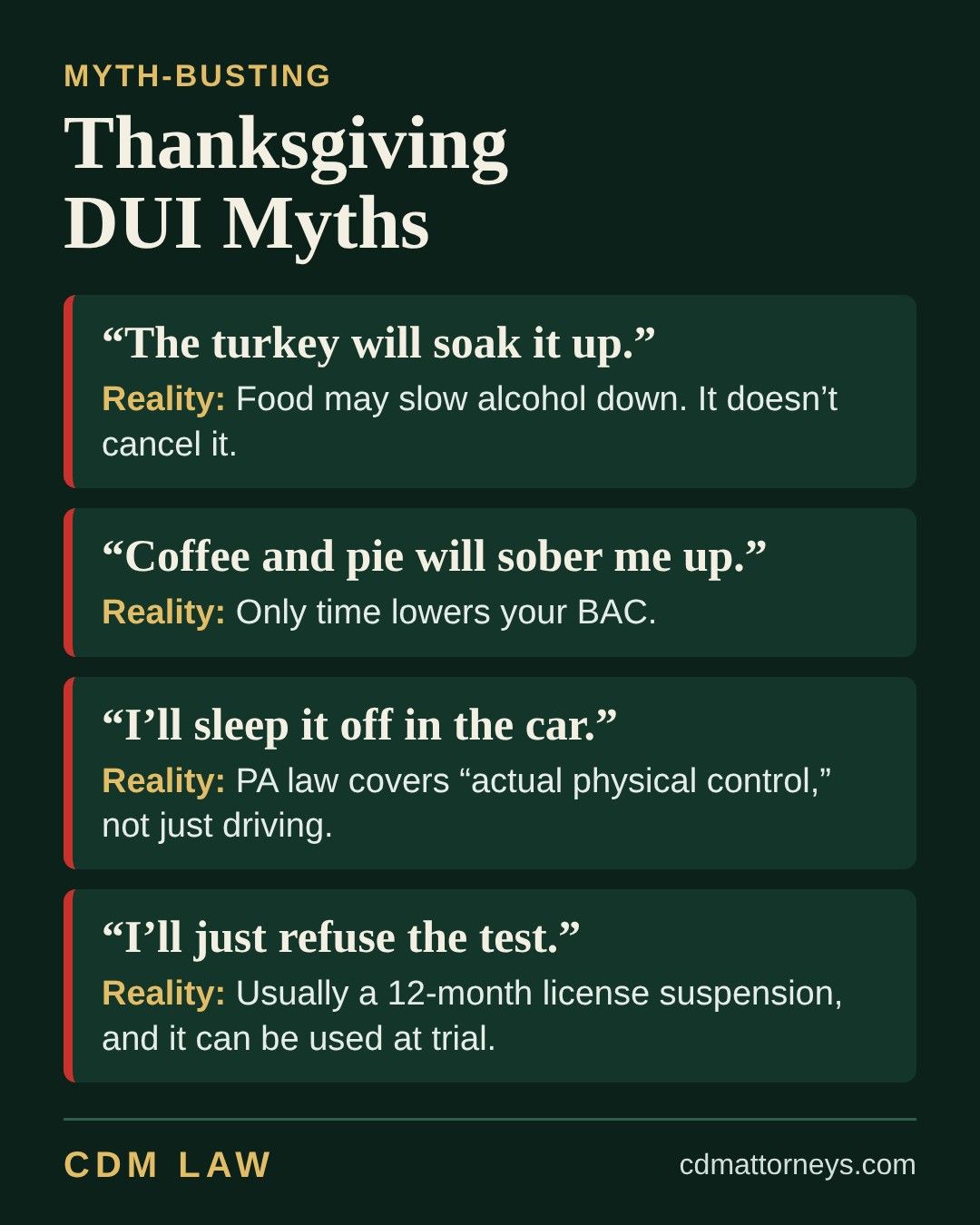
Myth 1: “The turkey will soak it up.”
A big meal may slow how fast your body absorbs alcohol. It does not erase it. Two helpings of stuffing are not a designated driver.
Myth 2: “I’m not drunk, officer. It’s the tryptophan.”
Blaming the turkey is a time-honored tradition. It is not a legal defense. Pennsylvania’s general impairment provision, 75 Pa.C.S. § 3802(a)(1), makes it illegal to drive after drinking enough alcohol that you are “incapable of safely driving.” That charge does not require any particular BAC number. Food coma plus wine is still impairment.
Myth 3: “Coffee and pie will sober me up.”
Coffee makes you a more alert impaired driver. Pie makes you a happier one. Only time brings your blood alcohol concentration (BAC) down.
Myth 4: “I’ll just sleep it off in the car.”
Pennsylvania’s DUI statute does not only cover driving. It covers anyone who drives, operates or is “in actual physical control of the movement of a vehicle” while impaired. Whether a parked car counts depends on the facts, such as where the car is and whether the engine is running. Do yourself a favor and make the couch, not the driver’s seat, your guest room.
Myth 5: “It’s Friday morning. I’m fine for the doorbusters.”
If the party went late, you may still have alcohol in your system when the alarm goes off. Pennsylvania’s BAC tiers are measured from a test taken within two hours after driving, so the “morning after” can still produce a DUI. No TV deal is worth that.
Myth 6: “If I refuse the breath test, they can’t prove anything.”
Refusing usually makes things worse, not better. We explain why below.
Pennsylvania DUI penalties at a glance
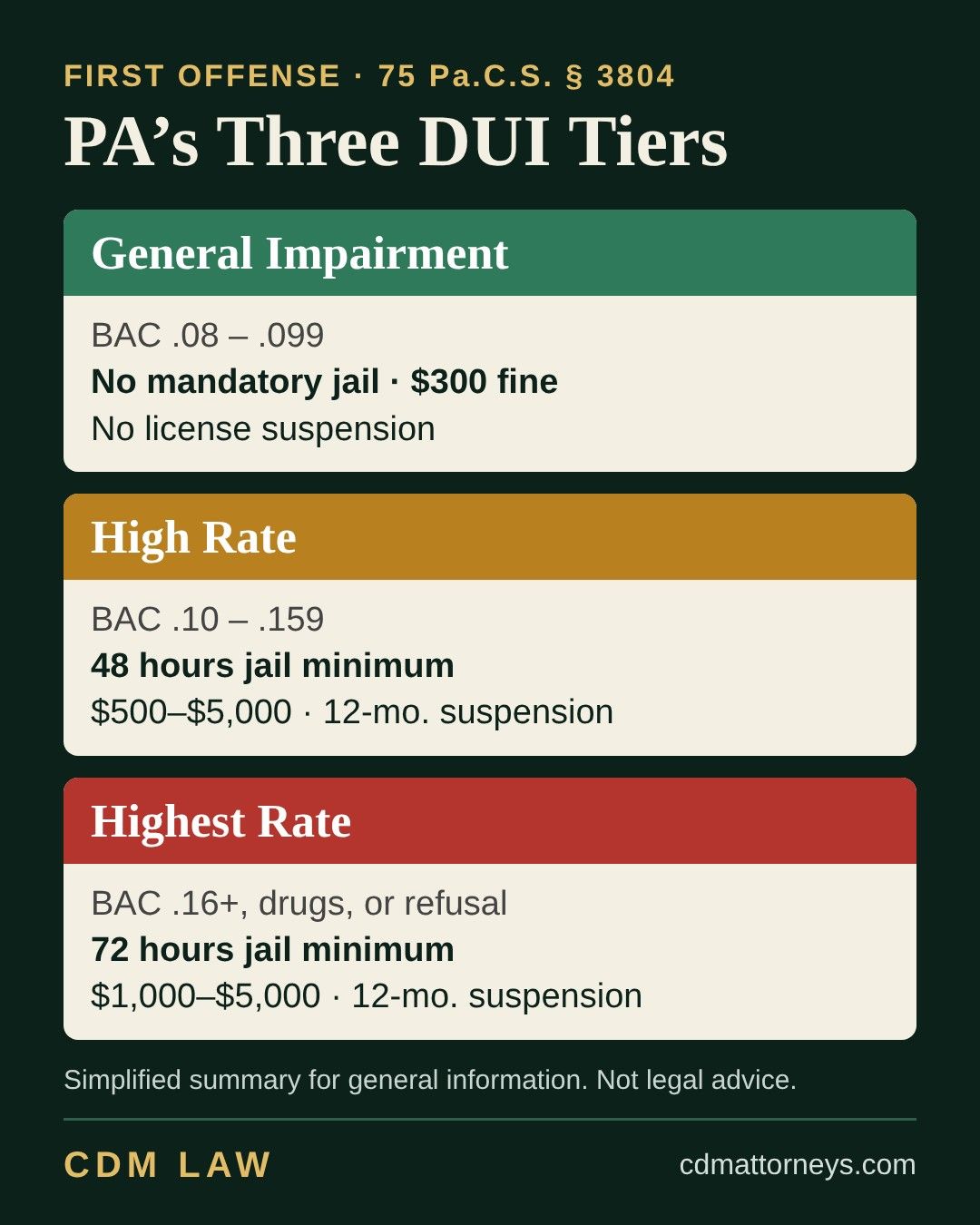
Pennsylvania sorts most DUI cases into three tiers based on BAC ( 75 Pa.C.S. §§ 3802 and 3804). The higher your BAC and the more prior offenses you have, the steeper the mandatory minimums.
| Tier | Who it covers | First offense (minimums) | Second offense (minimums) |
|---|---|---|---|
| General impairment | BAC .08% to under .10%, or impaired with no specific BAC | 6 months’ probation, $300 fine, no jail; no license suspension (no prior offense) | 5 days in jail; $300 to $2,500 fine |
| High rate | BAC .10% to under .16%; also drivers under 21 at .02% or more, commercial drivers at .04% or more, and certain DUIs involving an accident | 48 consecutive hours in jail; $500 to $5,000 fine; 12-month license suspension | 30 days in jail; $750 to $5,000 fine |
| Highest rate | BAC .16% or more; drug DUIs; and refusal of breath testing (or of a blood test under a warrant) | 72 consecutive hours in jail; $1,000 to $5,000 fine; 12-month license suspension | 90 days in jail; fine of at least $1,500 |
Every tier also requires alcohol highway safety school and compliance with any drug and alcohol treatment ordered after evaluation. Repeat offenses bring longer license suspensions, and drivers with a prior offense generally must install an ignition interlock device to get their license back ( 75 Pa.C.S. § 3805). Having a child under 18 in the car makes things significantly worse. Drug DUIs, including cannabis-related cases, are their own complicated area; see our page on marijuana-related DUI in Pennsylvania.
New for 2026: “DUI following diversion” if you’ve had ARD
Many first-time DUI defendants in Pennsylvania resolve their cases through Accelerated Rehabilitative Disposition (ARD), a diversion program that can lead to dismissal and expungement after successful completion ( 75 Pa.C.S. § 3807). For years, a big question was whether an old ARD could be counted as a “prior offense” if the person was arrested again.
In 2025, the Pennsylvania Supreme Court held in Commonwealth v. Shifflett , 335 A.3d 1158 (Pa. 2025), that a prior ARD could not be used that way to increase a later DUI sentence. The General Assembly responded quickly. Act 58 of 2025, enacted on December 22, 2025 and effective immediately, created a brand-new offense: driving under the influence following diversion, found in 75 Pa.C.S. § 3802(h).
- What it covers: a DUI committed within 10 years after completing ARD (or a similar out-of-state diversion program) for a prior DUI.
- Second-offense-level penalties: even if it is your first “conviction,” a DUI following diversion carries the mandatory minimums Pennsylvania uses for second offenses: at least 5 days, 30 days or 90 days in jail, depending on the underlying tier.
- Higher grading: if the new case involves a refusal, the highest BAC tier or drugs, it is graded as a first-degree misdemeanor (§ 3803(c)(2)).
- The paper trail lasts: even after ARD expungement, the clerk of courts keeps a non-public certified record for 12 years for use in these prosecutions.
Translation for the dinner table: if Uncle Ray did ARD in 2019, this is not the year for “one for the road.” For more on how ARD works and what happens if it goes sideways, read our post on violating ARD and the 2026 Worzel decision.
On the horizon: Act 36 of 2026, enacted July 20, 2026, overhauls Pennsylvania’s ignition interlock license rules, with many of its changes scheduled to take effect 16 months after enactment. If you are already dealing with a suspension, ask your lawyer how the timing affects you.
Refusing the test: the gravy boat you don’t want to pass
Under Pennsylvania’s implied consent law, 75 Pa.C.S. § 1547, anyone who drives in Pennsylvania is “deemed to have given consent” to chemical testing of breath or blood when police have reasonable grounds to believe the person was driving under the influence. Saying no after a DUI arrest has its own set of consequences:
- License suspension: 12 months, or 18 months if you have a prior refusal suspension or a prior DUI sentence. This comes from PennDOT and is separate from the criminal case.
- Tougher criminal penalties: refusing a breath test and then being convicted of general impairment DUI puts you in the highest penalty tier, starting at 72 hours in jail for a first offense.
- It can be used at trial: prosecutors may introduce the refusal as evidence.
- Restoration fees: getting your license back after a refusal suspension costs $500 for a first suspension and more for repeat suspensions.
The rules on blood tests are more nuanced than the rules on breath tests, and how the officer read the warnings matters. If you were asked for a test and something felt off, tell your lawyer exactly what was said.
Stopped on the way to (or from) Grandma’s? Do this
- Pull over safely and stay calm. Keep your hands visible and turn on the interior light at night.
- Hand over your license, registration and proof of insurance.
- Be polite, and don’t debate the night’s menu. You can politely decline to answer questions about where you were or how much you drank.
- Listen carefully to any chemical test warnings. The refusal consequences above are serious.
- Write everything down as soon as you can: time, location, what was said and who was there.
- Call a DUI lawyer quickly. PennDOT notices come with short appeal deadlines, and early decisions can affect ARD eligibility.
For more on checkpoints and what to expect during the holiday crackdown, see Halloween to New Year’s: What Pennsylvania Drivers Need to Know About Holiday DUI Enforcement.
Your Thanksgiving game plan
- Designate a driver before you designate who carves. Then actually let them drive.
- Use a rideshare, a taxi or public transit. It costs less than a fine, and much less than a lawyer.
- Inflate the air mattress. A night on the couch beats a night in a holding cell.
- Give yourself time on Friday morning. The doorbusters will be there at 10 a.m. too.
- Hosts: stock the mocktails and card the cousins. Knowingly furnishing alcohol to anyone under 21 is a misdemeanor in Pennsylvania with a mandatory minimum $1,000 fine ( 18 Pa.C.S. § 6310.1). Our Thanksgiving guide for hosts, parents and drivers covers the rest.
- Save our number: (610) 994-0281. We hope you never need it.
Charged with DUI this Thanksgiving? Talk to CDM LAW.
A DUI arrest over the holiday weekend can put your license, your job and your record at risk, and the deadlines start running right away. CDM LAW defends drivers in Montgomery County, Philadelphia and throughout Southeastern Pennsylvania. Founder Christopher D. Mandracchia served as an Assistant District Attorney in Berks County from 2010 through 2015, so he knows how DUI cases are built and where they can fall apart: the stop, the checkpoint, the testing procedure and the paperwork.
We can review whether you may qualify for ARD, challenge the evidence, and help you deal with a PennDOT suspension.
Request a confidential consultation Call (610) 994-0281
Learn more about our Pennsylvania DUI and traffic defense practice.
Pennsylvania Thanksgiving DUI FAQs
What is the legal BAC limit in Pennsylvania?
For most adult drivers, a BAC of .08% or more within two hours of driving supports a DUI charge. The limit is .02% for drivers under 21 and for school bus drivers, and .04% for commercial vehicle drivers. A driver can also be charged with general impairment DUI without any specific BAC number.
Will I go to jail for a first DUI in Pennsylvania?
It depends on the tier. A first-offense general impairment DUI carries no mandatory jail time. A first offense carries at least 48 hours at the high rate and at least 72 hours at the highest rate, for drug DUIs and for most refusals. Many first-time offenders may be eligible for ARD, which can avoid a conviction.
What happens if I refuse a breath test in Pennsylvania?
A refusal after a DUI arrest generally triggers a 12-month license suspension (18 months with certain priors), can be introduced as evidence at trial, and can push a general impairment conviction into the highest penalty tier.
I completed ARD years ago. Does a new DUI count as a second offense?
If the new DUI happens within 10 years after you completed ARD, you may be charged with “DUI following diversion” under Act 58 of 2025. It carries the same mandatory minimum jail terms as a second DUI.
Are there DUI checkpoints in Pennsylvania over Thanksgiving?
Yes. Pennsylvania’s Operation Safe Holiday impaired-driving enforcement runs from November 25, 2026 through January 1, 2027 and includes sobriety checkpoints, roving patrols and regular traffic patrols.
Attorney advertising. This post is published by CDM LAW, LLC, Conshohocken, Pennsylvania. 815 Fayette Street, Suite 200, Conshohocken, PA 19428. Christopher D. Mandracchia, Esq. is responsible for its content.
Not legal advice. This article provides general information about Pennsylvania law as of November 24, 2026. It is not legal advice and should not be relied on as such. Statutes are summarized in simplified form and include exceptions not described here. Laws, court decisions and enforcement programs change. Every case depends on its own facts, and past results do not guarantee a similar outcome.
No attorney-client relationship. Reading this post, calling our office or sending us a message does not create an attorney-client relationship. Please do not send confidential information until we have confirmed in writing that we represent you.
About the numbers and the jokes. State Police statistics cover only incidents investigated by the Pennsylvania State Police. The humor in this post is about the holiday, never about impaired driving: if you have been drinking or using drugs, do not drive. In an emergency, call 911. Images are original illustrations created for CDM LAW.
Sources
- 75 Pa.C.S. §§ 3802, 3803, 3804, 3805, 3806 and 3807, including history notes for Act 58 of 2025 (P.L. 363, No. 58) and Act 36 of 2026 (P.L. 436, No. 36): Pennsylvania General Assembly, Title 75, Chapter 38
- 75 Pa.C.S. § 1547 (chemical testing and refusal): Pennsylvania General Assembly
- 18 Pa.C.S. § 6310.1 (selling or furnishing liquor to minors): Pennsylvania General Assembly
- Commonwealth v. Shifflett , 335 A.3d 1158 (Pa. 2025)
- Pennsylvania State Police, “State Police Report 1,183 Crashes, 458 DUI Arrests Over the Thanksgiving Holiday” (Dec. 2, 2025): pa.gov
- WGAL, “Pennsylvania State Police step up holiday DUI patrols statewide” (Nov. 10, 2026): wgal.com