
Pay $1 Million to Walk Away? What College Football's Buyout Fight Teaches About Pennsylvania Contract Disputes
Buyouts, exit fees and liquidated damages under Pennsylvania law, and what Montgomery County businesses, employees, athletes and families should know before they sign
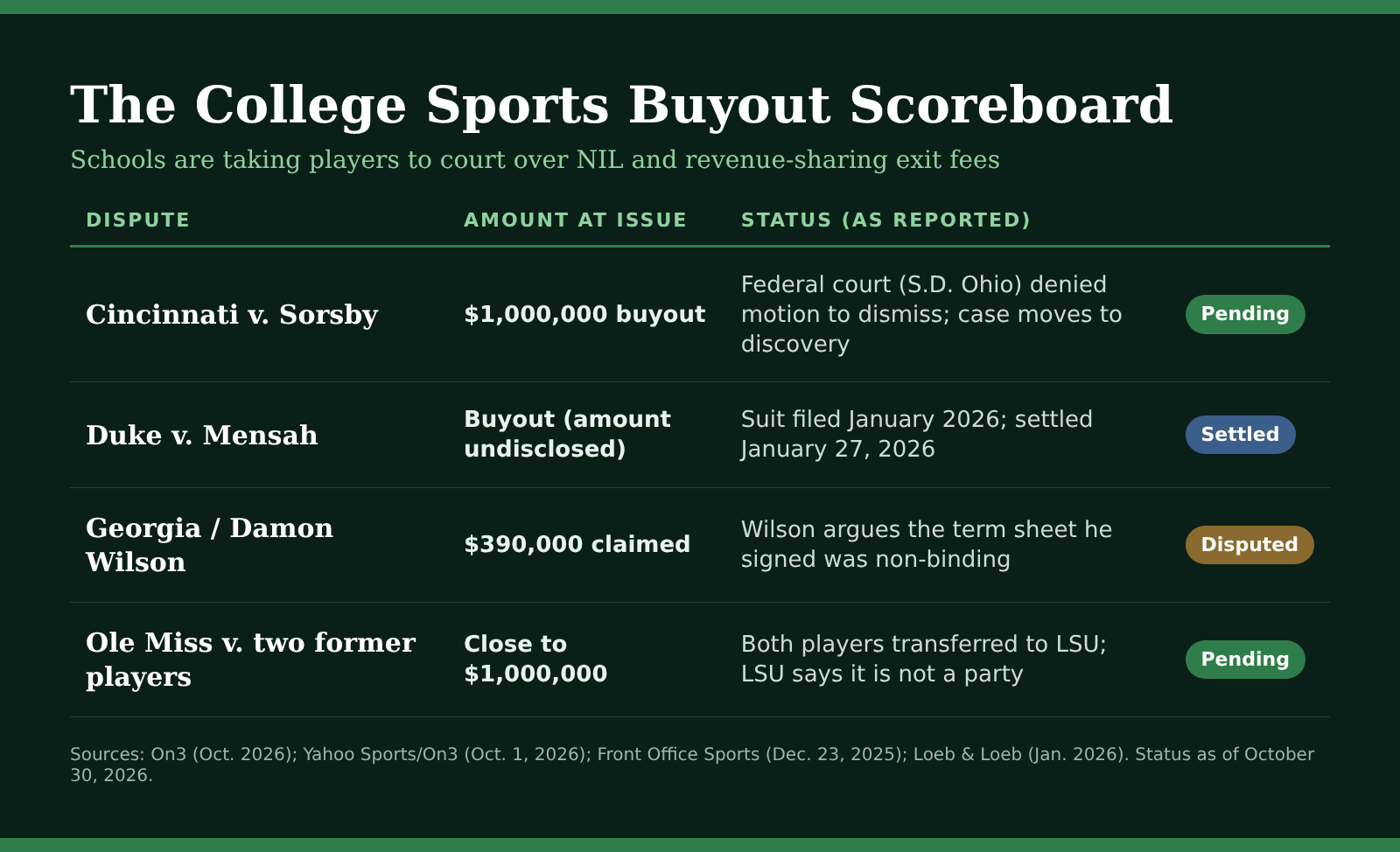
One of college football's most-watched fights is not happening on the field. It is happening in federal court. This week, reports confirmed that a federal judge in Ohio denied former Cincinnati quarterback Brendan Sorsby's motion to dismiss the University of Cincinnati's breach of contract lawsuit, which seeks a $1 million buyout after Sorsby transferred to Texas Tech. The case now moves into discovery.
The headline is about college sports. The legal question is one we see in Montgomery County every week: when a contract says you must pay a set amount to walk away, will a court actually make you pay it? In Pennsylvania, the answer depends on whether that number is a legitimate estimate of the other side's loss or a penalty dressed up as one.
The Case Everyone Is Talking About
According to published reports, Sorsby signed a multi-year NIL revenue-sharing agreement with Cincinnati in July 2025. Cincinnati says the agreement required him to stay for two seasons or pay a buyout within 30 days of transferring. He was paid $875,800 for the 2025 season, entered the transfer portal in December 2025, and signed with Texas Tech in January 2026. Cincinnati sued in the U.S. District Court for the Southern District of Ohio (University of Cincinnati v. Sorsby, No. 1:26-cv-00200).
Sorsby's lawyers argued that the $1 million demand is an "unreasonable and disproportionate penalty" under Ohio law and asked the court to throw out Cincinnati's claims for liquidated damages and attorney's fees. The court declined to end the case at the pleading stage. That ruling does not decide who wins. It means the dispute will be decided on the evidence.
Sorsby is not alone:
- Duke and Darian Mensah: Duke sued its quarterback in January 2026 to enforce his NIL agreement. The parties settled on January 27, reportedly with a buyout paid to Duke.
- Georgia and Damon Wilson: Georgia and its NIL collective are seeking $390,000 from the former Bulldog, who argues the term sheet he signed was non-binding.
- Ole Miss: The school is suing two former players, now at LSU, for close to $1 million.
With the regular season ending in late November and the transfer portal opening in January, more of these disputes are expected. Congress is paying attention, too. The U.S. Senate passed the Protect College Sports Act of 2026 (S. 4668) on September 28, 2026, but the bill has not passed the House and is not law.
Why This Matters in Conshohocken and Montgomery County
You do not need to be a Power Four quarterback to sign a contract with a price tag on leaving. The same kind of clause shows up in:
- Commercial leases: early-termination fees, familiar to the many businesses that lease office space in Conshohocken, Plymouth Meeting and King of Prussia.
- Employment agreements: repayment of a signing bonus, relocation money or training costs if you leave early, often paired with a non-compete.
- Vendor, software and service contracts: cancellation fees and "remaining term" acceleration clauses.
- Construction contracts: a fixed daily rate for late completion.
- NIL and revenue-sharing agreements: Montgomery County athletes headed to Penn State should know that the Big Ten is the only Power Four conference with a league-wide revenue-sharing contract template.
What Pennsylvania Law Says
1. Every breach of contract claim starts with three elements. The party suing must establish (1) the existence of a contract, including its essential terms, (2) a breach of a duty imposed by the contract, and (3) resultant damages. CoreStates Bank, N.A. v. Cutillo, 723 A.2d 1053, 1058 (Pa. Super. 1999). If the "contract" is really a non-binding term sheet without its essential terms, which is Damon Wilson's argument, the claim can fail at step one.
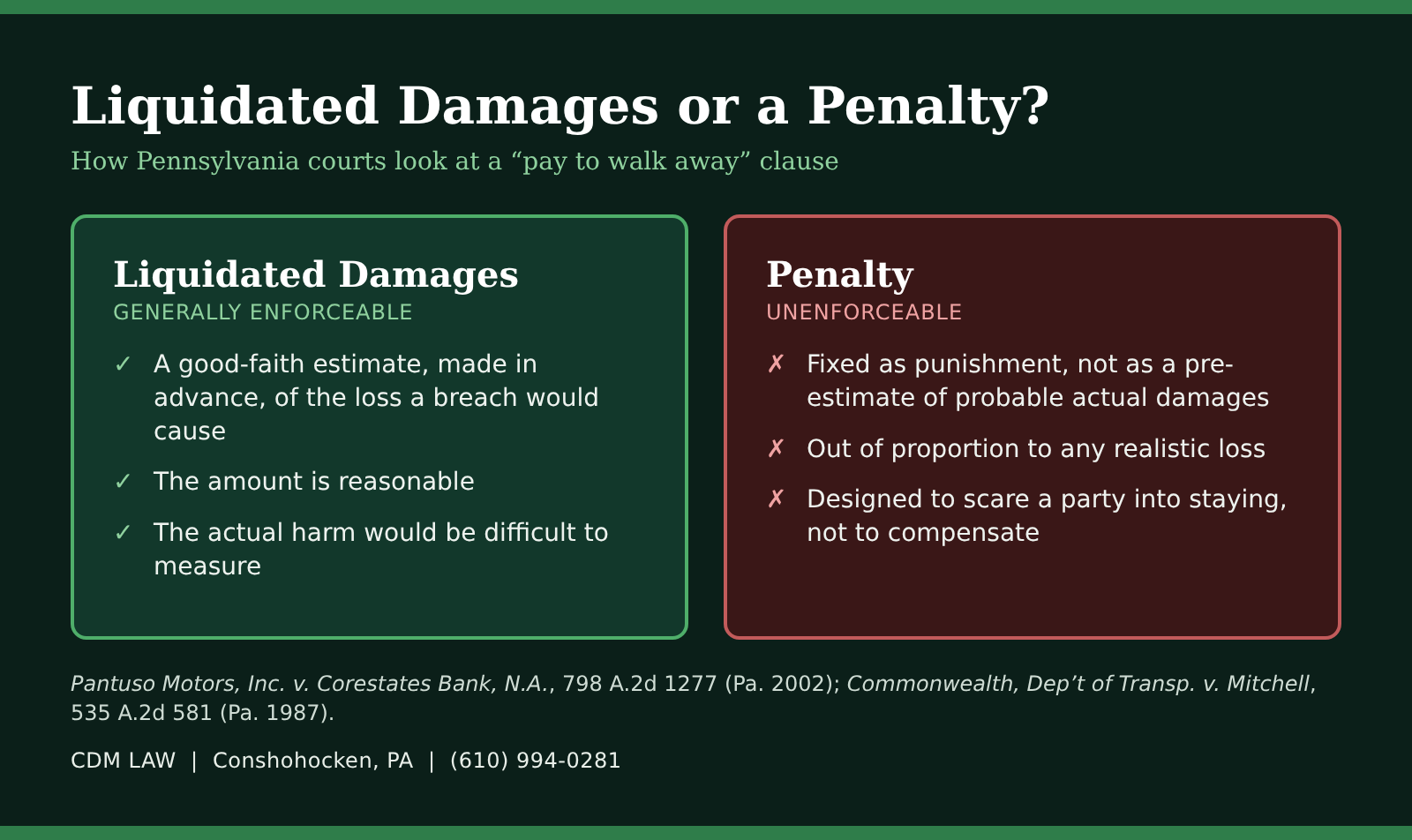
2. Liquidated damages can be enforced. Penalties cannot. Liquidated damages are the sum a party agrees to pay if it breaks a promise, arrived at by a good-faith effort to estimate the actual damage in advance. Pennsylvania courts enforce them where the amount is reasonable and the harm caused by a breach is difficult to assess. Pantuso Motors, Inc. v. Corestates Bank, N.A., 798 A.2d 1277 (Pa. 2002); Commonwealth, Dep't of Transp. v. Mitchell, 535 A.2d 581 (Pa. 1987). A penalty, by contrast, is fixed "not as a pre-estimate of probable actual damages, but as a punishment." Pantuso, 798 A.2d at 1282. Calling a clause "liquidated damages" in the contract does not end the analysis.
3. A court will not order you to perform, but it may order you to pay. Courts generally will not specifically enforce a promise to render personal services. Restatement (Second) of Contracts § 367(1). Pennsylvania treats restrictions on where a person may work as restraints of trade and enforces them "only so far as reasonably necessary" to protect a legitimate interest. Hess v. Gebhard & Co., 808 A.2d 912, 917 (Pa. 2002); see also Socko v. Mid-Atlantic Sys. of CPA, Inc., 126 A.3d 1266 (Pa. 2015). That is why most of these fights end up being about money.
4. Each side usually pays its own lawyer, unless the contract says otherwise. Pennsylvania follows the American Rule: litigants pay their own counsel fees unless there is express statutory authorization, a clear agreement of the parties, or another established exception. Trizechahn Gateway LLC v. Titus, 976 A.2d 474, 482–83 (Pa. 2009). A fee-shifting clause can double the stakes, which is why Sorsby's motion targeted Cincinnati's attorney's fee claim as well as the buyout.
5. The clock is running. An action upon a written contract generally must be commenced within four years. 42 Pa.C.S. § 5525(a)(8). The same four-year period applies to an express contract not founded upon a writing. 42 Pa.C.S. § 5525(a)(3).
6. Pennsylvania has its own NIL law. Pennsylvania's college-athlete name, image and likeness statute, first enacted by Act 26 of 2021 and now found in Article XX-M of the Public School Code of 1949, protects a student-athlete's right to earn NIL compensation and allows athletes to be represented by an athlete agent under Pennsylvania's athlete-agent law or by an attorney admitted to practice in Pennsylvania.
Where a Contract Dispute Is Heard in Montgomery County
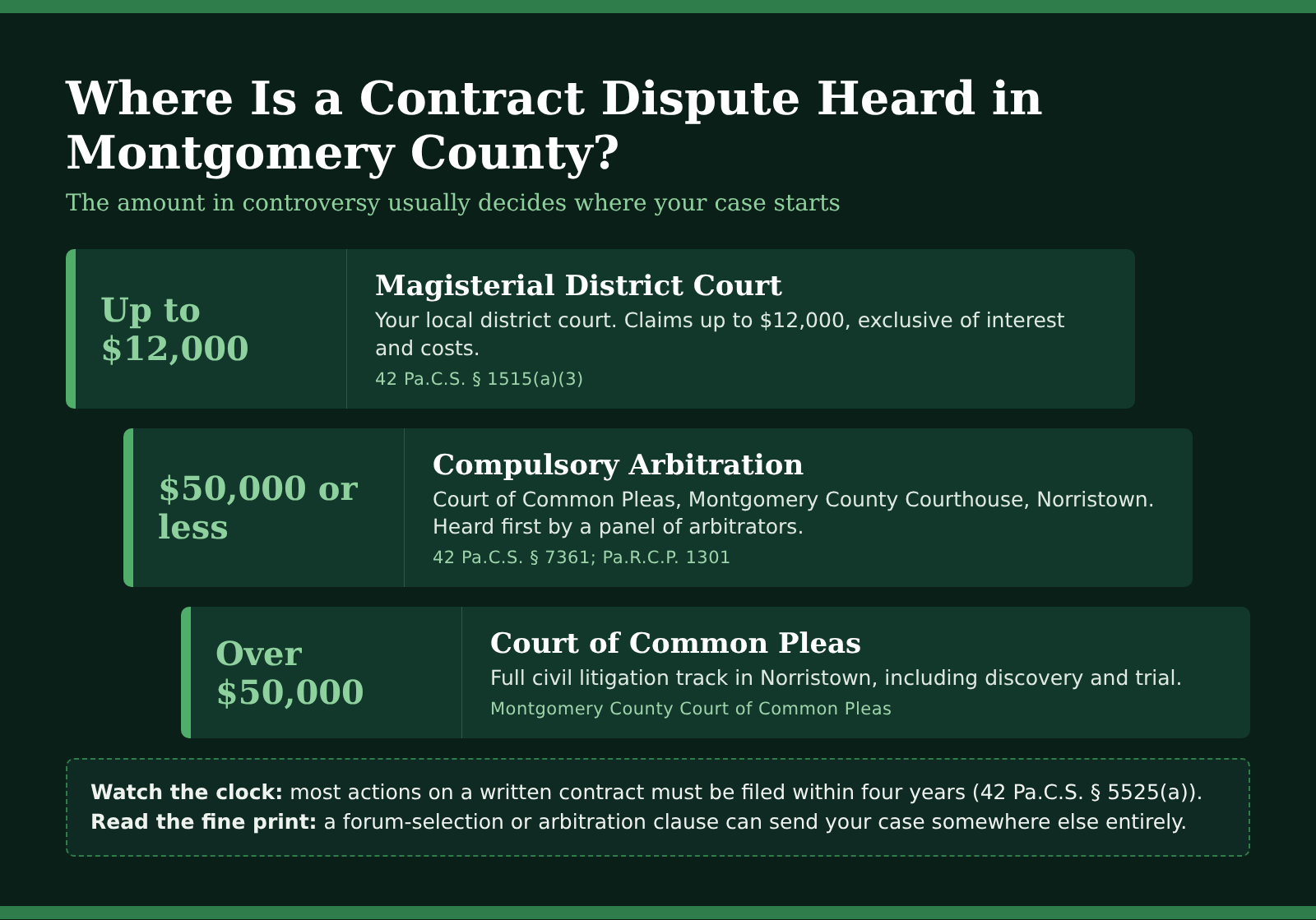
- Up to $12,000: Claims up to $12,000, exclusive of interest and costs, may be filed with the local magisterial district judge. 42 Pa.C.S. § 1515(a)(3).
- $50,000 or less: In the Court of Common Pleas at the Montgomery County Courthouse in Norristown, these claims generally go to compulsory arbitration first. 42 Pa.C.S. § 7361; Pa.R.C.P. 1301.
- Over $50,000: The case proceeds on the Court of Common Pleas litigation track, including discovery and trial.
A forum-selection or arbitration clause can change all of this. Sorsby now plays in Texas, but he is defending Cincinnati's lawsuit in an Ohio federal court, and the fight over his buyout turns on Ohio law. Read that clause before you sign, not after you are served.
Before You Sign a Contract With an Exit Fee
- Find the number and the trigger. Know exactly what event (resigning, transferring, terminating early) requires payment, and when it is due.
- Ask how the number was calculated. A figure tied to a realistic estimate of loss is far more likely to be enforced than a round number chosen to discourage you from leaving.
- Look for a fee-shifting clause. If you lose, you may be paying both lawyers.
- Check choice of law and forum. A Conshohocken resident can end up litigating in another state.
- Read every related agreement together. Buyout language often sits in one document while the rest of the money flows through another.
- Have it reviewed before you sign. Damon Wilson alleges he signed his term sheet without legal representation. Do not put yourself in that position.
Already Facing a Buyout or Exit-Fee Demand?
- Do not ignore it. Contract deadlines and court deadlines both matter.
- Preserve everything: the contract, emails, texts and payment records.
- Evaluate your defenses, including whether the clause is an unenforceable penalty, whether the other side breached first, and whether a binding contract was ever formed.
- Consider early resolution. Duke and Mensah settled about a week after the suit was filed.
How CDM Law Can Help
CDM Law represents individuals, families and businesses in contract disputes throughout Montgomery County and Southeastern Pennsylvania. From our office at 815 Fayette Street in Conshohocken, our attorneys can:
- Review employment, lease, vendor, construction and NIL agreements before you sign
- Draft liquidated damages and termination provisions designed to hold up in court
- Respond to buyout, exit-fee and early-termination demands
- Negotiate settlements that close the matter on clear terms
- Litigate contract disputes from the local magisterial district court to the Montgomery County Courthouse in Norristown
Whether you want to enforce a contract or get out of one, the time to call is before the deadline passes. Contact CDM Law at (610) 994-0281 or cdm@cdmattorneys.com to schedule a consultation.
Frequently Asked Questions
Are liquidated damages clauses enforceable in Pennsylvania?
Yes, if the amount is reasonable and the harm from a breach would be difficult to assess. A clause that operates as a punishment is an unenforceable penalty. Pantuso Motors, Inc. v. Corestates Bank, N.A., 798 A.2d 1277 (Pa. 2002).
How long do I have to sue for breach of a written contract in Pennsylvania?
Generally four years. 42 Pa.C.S. § 5525(a)(8).
Can I recover my attorney's fees in a Pennsylvania contract case?
Usually only if a statute or the contract itself allows it, or another established exception applies. Trizechahn Gateway LLC v. Titus, 976 A.2d 474, 482–83 (Pa. 2009).
Sources
News reports: On3, "Brendan Sorsby's motion to dismiss Cincinnati breach-of-contract lawsuit denied" (Oct. 2026); On3/Yahoo Sports, "Inside college football's looming contract fight" (Oct. 1, 2026); Express-News/Yahoo Sports, "University of Cincinnati sues ex-QB Brendan Sorsby" (Feb. 26, 2026); Loeb & Loeb, "Duke University Settles Groundbreaking NIL Lawsuit Against Quarterback" (Jan. 2026); Front Office Sports, "Georgia, Ex-Football Player Suing Each Other in NIL Dispute" (Dec. 23, 2025); National Law Review, "Federal NIL Law Is Coming" (Oct. 29, 2026).
Legal authority: 42 Pa.C.S. § 1515; 42 Pa.C.S. § 5525; 42 Pa.C.S. § 7361; Article XX-M, Public School Code of 1949 (Pa. Department of State); CoreStates Bank, N.A. v. Cutillo, 723 A.2d 1053 (Pa. Super. 1999); Pantuso Motors, Inc. v. Corestates Bank, N.A., 798 A.2d 1277 (Pa. 2002); Commonwealth, Dep't of Transp. v. Mitchell, 535 A.2d 581 (Pa. 1987); Hess v. Gebhard & Co., 808 A.2d 912 (Pa. 2002); Socko v. Mid-Atlantic Sys. of CPA, Inc., 126 A.3d 1266 (Pa. 2015); Trizechahn Gateway LLC v. Titus, 976 A.2d 474 (Pa. 2009); Restatement (Second) of Contracts § 367.
This post is for general informational purposes only and is not legal advice. Reading it or contacting CDM Law does not create an attorney-client relationship. Laws change and their application depends on the specific facts of each matter; you should consult a licensed Pennsylvania attorney about your situation. This post may be considered attorney advertising. Prior results do not guarantee a similar outcome.